
21 Miles in Malibu
6/18/2026 | 56m 42sVideo has Closed Captions
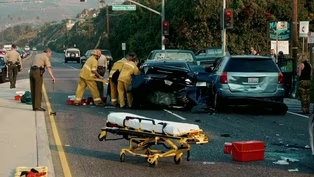
One road. Two families. 50 years of death along a 21-mile stretch of PCH. It must change.
Since 1975, 205 people have died on a single 21-mile stretch of Pacific Coast Highway. This documentary follows two families whose lives were shattered by the same road under completely different circumstances and asks why the most iconic stretch of asphalt in America remains one of its deadliest.
Problems playing video? | Closed Captioning Feedback
Problems playing video? | Closed Captioning Feedback
21 Miles in Malibu is a local public television program presented by PBS SoCal
21 Miles in Malibu
6/18/2026 | 56m 42sVideo has Closed Captions
Since 1975, 205 people have died on a single 21-mile stretch of Pacific Coast Highway. This documentary follows two families whose lives were shattered by the same road under completely different circumstances and asks why the most iconic stretch of asphalt in America remains one of its deadliest.
Problems playing video? | Closed Captioning Feedback
Where to Watch 21 Miles in Malibu
21 Miles in Malibu is available to stream on pbs.org and the PBS app.
Providing Support for PBS.org
Learn Moreabout PBS online sponsorshipannouncer: The opinions expressed in this documentary do not reflect those of PBS SoCal.
This program is made possible, in part, by Blue Line Solutions, a traffic safety company.
["Goin' to Malibu" by The Malibooz playing] [music] [music] ♪ I hop in my woody, Put my board inside.
♪ ♪ Skeg out the window And my baby by my side.
♪ ♪ I'm goin' to Malibu to ride the surf, Yeah ride.
♪ ♪ When the surf is up and the waves roll in.
♪ ♪ Don't back down, baby, be a sin.
♪ ♪ I'm goin' to Malibu to ride the surf, yeah ride.
♪ speaker: Malibu continues to hold the near mythical allure with over 20 miles of pristine Pacific Ocean front.
Robert Frank: The king of late night television, Johnny Carson, this is his former home in Malibu, and it comes with Johnny's koi fish and a very special tennis court.
♪ Gilgo Beach might be all right for you.
♪ ♪ But us cool surfers go to Malibu.
♪ ♪ I'm goin' to Malibu to ride the surf.
♪ speaker: Malibu is this little oasis where wealthy people and average people get away, relax, and enjoy the natural beauty.
speaker: All this is Chumash land, and we decided to make it a glamping experience.
speaker: I'm so excited!
[music] [music] [engine revving] [vehicle crashing] reporter: Deputies call off a pursuit in Malibu, saying it is simply too dangerous.
And then moments later there was a fiery crash, and a man is killed.
reporter: The deadly collision happened just after noon and left two people dead and two others injured.
The cars so mangled, I'm told firefighters had to pry the doors open of both cars to reach the bodies inside.
reporter: Another terrifying sight.
Two cars collided head on, setting one of them in the ocean below.
reporter: The news of the crash has heightened concerns over safety out here.
This was the fourth major wreck on this stretch of PCH within the past month.
Terry Goldberg: I'm a taxpayer, I pay taxes just like everyone else.
And I resent that PCH isn't safe, and everyone knows that, and no one's done anything about that.
[music] Jefferson Wagner: Since my surf shop lease started in 1978, I have seen nine fatal collisions or deaths from this exact spot where I'm standing.
Fireball Tim Lawrence: The dangers on PCH are virtually limitless.
You know, I'd like to say that there is some kind of statistic that could say, well, there's certain things happen in certain ways, but they don't.
Lou Lamonte: One of the reasons that there are more accidents on the PCH generally is you have a five-lane state highway going through a residential area.
Our main street is the PCH.
Hans Laetz: So is it supposed to be a highway, or is it Malibu's main street with people walking on it?
It has a split personality, and people die!
Michel Shane: From the past summers, you'll see 750,000 people here, 500,000 people here, on a road that's been used and nothing has been changed since the '50s.
This road was never meant to handle that many people.
And then you add in the parking, the bicycles, the walking, the deliveries, and you're sitting there waiting for an accident to happen.
Lou Lamonte: Most cities have 2 or 3 miles of the PCH.
We have 21 miles.
[person screaming] Ah!
Lou Lamonte: Ultimately, we have a lot more stuff going on, specifically just because we have so much more of it to deal with.
And the more people you put on that highway, the more problems we have.
[police sirens] [dog barking] Michel Shane: No more cuddles.
Ellen Shane: Hi.
Who's here, guys?
speaker: This here, hello.
Ellen Shane: They're immediately searching for their toys.
Ellen Shane: So this was Emily's room.
So, I mean, there's a lot of stuff on the walls.
That was from her bat mitzvah, and I love that picture of the two of us because it was such a happy time.
And I actually found this just recently.
She mentions in here, "Going to my sister's bat mitzvah, I was bored because I didn't understand how important it was.
Then this year when it was my turn, it was an amazing experience and one I will never forget."
That picture is from this event, so to know that it meant so much to her really makes me so happy that she had that experience.
[music] Michel Shane: Emily was all about helping others and hated people to be alone.
She was the unofficial ambassador of the school, so if you were new to the school, Emily would take you under her wing till you were ready to figure out who your friends would be.
Lou Lamonte: Emily was such a part of the community.
My daughter and Emily played together in Little League.
I remember Emily, she was always smiling.
She had this little, you know, pink batting helmet and she would run around the bases in Little League.
She was a terrific kid.
Ellen Shane: She was a really good kid.
She was a sweet, kind person who didn't have a mean bone in her body.
And she loved Malibu, she loved it.
speaker: Career enhancing resume.
Rod Bergen: I'm Rod Bergen.
I've been a reserve deputy for almost 30 years with the sheriff's department.
speaker: Is it safe to assume that in your time as a deputy sheriff that you've seen a lot of accidents on the PCH?
Rod Bergen: More than I care to think about.
Fireball Tim Lawrence: You know, we've lived in Malibu for probably over 30 years at this point, and PCH is a living, breathing entity.
There's really no way to anticipate what this dragon is gonna be doing from day to day.
People bring their amazing cars out to this town because there's so many great places to see and things to do.
There's all kinds of wonderful things that you can experience if you come out here with the intention of enjoying yourself.
Rod Bergen: Malibu hasn't changed a whole lot, except that there are more people, more large homes.
When I first came here, I could ride my horse anywhere around Malibu.
It was pretty much open.
David K. Randall: There are so many stories behind the things that we take for granted.
You think PCH has always been there, you think Malibu has always been the place of movie stars, and you realize later that it's all because of a few people and those personalities that change things.
The Chumash Indians lived in what they called Maliwu.
The meaning of that name is lost, but it was thought to be where the mountains meet the sea.
This became one of many ranchos in California, and then eventually this was owned by a man named Frederick Rindge.
Hans Laetz: Frederick Rindge and his young bride, May Rindge, bought Malibu for pennies and created their very own Southern California idyllic retreat.
It was a way of life.
It was the original Malibu way of life.
David K. Randall: But Frederick eventually died, so May Rindge then inherited everything.
She instantly becomes one of the wealthiest women in the country and in charge of this really important place in California.
Hans Laetz: There were a bunch of ranchers who used to use the Adamson roads to get their produce to market and their kids to high school in Santa Monica, and Mrs.
Rindge cut them off.
David K. Randall: She didn't want anybody crossing across her land.
So when she hired a bunch of ranch hands and told them to patrol Malibu and to shoot anybody on sight, you know, she told them, "We don't fire warning shots here."
Hans Laetz: So guns were drawn, and people rode their horses down to the courthouse in Los Angeles and demanded that a public road be built.
That's the very beginning of Pacific Coast Highway.
Fireball Tim Lawrence: See, we barely even got started and someone wants to go first.
This is Rambla Vista, the street I live on currently.
I've been here for about 25 years.
But right down at the bottom of the hill was where the vaqueros would stand guard for her so that no one can make it in, you know, through the gate that they had built there.
My wife, Kathie, has been a surfer in Malibu since 1965.
Kathy Kohner, who was the original Gidget, is a friend of ours.
Yeah, Surfrider Beach is on the left.
Surfrider Beach was really the focus of the Beach Boys when they were writing songs and living beach culture in the '50s and through the '60s.
It's iconic because of the Malibu Pier, because of Surfrider Motel over here on the right, and it's a perfect wave.
♪ Feeling's the one that he craves.
♪ ♪ Don't try to explain.
♪ ♪ It's the call of the wave.
♪ Fireball Tim Lawrence: On the left up here is what we originally called Secos.
This is Leo Carrillo, great place to surf.
This is where they filmed "Point Break" and "Planet of the Apes."
George Taylor: You maniacs!
God damn you all to hell!
Brian O'Conner: Nice car.
What's the retail on one of those?
speaker: More than you can afford, pal, Ferrari.
[engine revving] Fireball Tim Lawrence: Once the highway opened, it was a zoo, you know, there was cars going left and right.
There we go.
Don't need a lane just to pass right in the center lane there.
speaker: Look at this.
Look at this right here.
Fireball Tim Lawrence: That's PCH.
Probably what makes traffic difficult in Malibu is the fact that it's a pass-through town, and people coming from Oxnard, from Calabasas, they're passing through to go to Santa Monica and vice-versa.
David K. Randall: When the first roads were built in Los Angeles, people instantly realized, hey, driving is a lot of fun.
So people go on joy rides through Malibu and people come back and say, "Wow, this is a beautiful, beautiful place, and we're prevented from going there."
Hans Laetz: People wanted to go for a drive on the beach, and right beyond Santa Monica was this beautiful stretch of untouched beach that nobody could get into.
So, May Rindge was hated in Los Angeles, absolutely hated.
There were like 12 different newspapers back then, and they were competing with each other to come up with terrible news about May Rindge.
She was the mean queen of Malibu.
David K. Randall: So it goes to California Supreme Court, May wins.
California then appeals to the US Supreme Court.
And what the justices come back with is the public deserves to see beautiful places, whether one person owns it or not.
It's a very landmark case in many ways because this has never been said before.
Hans Laetz: The US Supreme Court held that the state of California could build a state highway or a county road just for pleasure drive, and that's what they did.
David K. Randall: So it opens, and they have a ceremony with a woman dressed up as Miss Mexico, another one dressed up as Miss Canada, because this is the final link between the coastal highway that's gonna go all the way from Mexico to Canada.
The only person who doesn't attend is May.
It really is, in some ways, probably one of May's darkest days, because Malibu is now open.
People are gonna be crossing her land where it was only Rindges before.
Kelly Miyahara: Whenever I drive it, in my mind I'm on a bike.
I see the places we stopped to use the bathroom or the places we stopped to refuel our bottles, you know, oh, here comes that hill or whatnot, and in a car it's easy.
I miss it, but honestly, I'm afraid to ride it again.
So, my story involves friendship, a lot of sweat, tears, and some tragedy too.
So I started training for triathlons in 2010, continued and got suckered into full Ironman distance triathlons by a lot of persuasive people.
And became really close with a lot of those people.
Marisela had the most electric smile.
Everybody knows it.
Everybody noticed it.
She's just one of those really cool, even-keeled, silly, and fun people.
Our team started training at the beginning of 2012.
We rode the PCH, you know, most weekends, sometimes even during the week.
And the night before our race, Marisela had gotten a phone call from her family and so the morning of our race, she wasn't there.
Marisela's father died the night before our race and so she wasn't able to race with us in Canada.
Obviously, you know, we wanted to support her through the loss.
But a few weeks later, the subject came up of, I did all that training and I still want to finish.
Raul Ortega: The first time I met up with her after Canada, she told me, "I wanna do an Ironman.
I wanna finish," and she said, "Will you train with me?"
And I said, sure.
It must have been like three or four years that I was on PCH on a regular basis, pretty much two or three weekends a month, so we went on PCH many times.
[sounds of traffic] Jefferson Wagner: Thank you.
So here we're putting the rental fleet away today, just about everything got out into the hands of the public.
This is the best sound of the day, happy times, good night.
I'm Jefferson Wagner, AKA Zuma Jay in the city of Malibu.
I've had a 25-year career as a special effects one card and an ATF Class 3 weapons handler.
One of the most favorite videos I did was "Freak on a Leash" by the group Korn.
♪ Something takes a bite of me ♪ Jefferson Wagner: Got the Best Special Effects Grammy.
speaker: Do you remember your first visit to Malibu?
Jefferson Wagner: I was age eight--seven or eight, somewhere in there.
The sand was so clean, it would squeak under your feet when you walked across it.
That's how clean the sand was back in the '60s.
I've had the lease at this location since late '77 or early '78, and then I lived in the back for 13 years on the floor.
speaker: Hold please.
[sirens] Jefferson Wagner: Okay, first responders going to work, like right in the middle of an interview.
So here we got something, let's see what's coming.
I have seen nine fatal collisions or deaths from this exact spot where I'm standing.
One of them was a very good friend of mine, speeding, flipped his jeep three or four times, deceased, covered with the yellow tarp, wait for the coroner.
The second fatality was a motorcycle incident where a car pulled out, hit the motorcycle.
The body was spinning.
He either hit the curb or the hydrant, and that's where he died.
He had no helmet on.
He was there for four or five hours while we were trying to do business.
It was disturbing to see a dead guy 75 feet from my door.
The third fatality that I actually saw was when a woman committed suicide by stepping off the sidewalk directly in front of high-speed traffic.
The other six fatalities are simple fatalities like what we see here going on, crossing the street at an angle next to high-speed traffic.
So that's nine within the sight of this front door.
You always wanna participate in your community.
Being a cop was one way, a couple of years of that was enough.
You can do actually a little more for the community in an elected position.
You can kind of head the community in a direction that you feel is valuable for the entire community overall.
By the end of my next term, I will have had eight years in an elected position here in the city of Malibu.
And I would say about 20% of your activities at City Hall involve Pacific Coast Highway.
There's no real serious awareness campaign about the tragedies and the mishaps that happen on this highway daily.
[music] [music] Ellen Shane: It was Easter weekend.
Emily had had a sleepover the night before, so we had not seen her.
The last time I saw her, I remember it vividly.
They had slept in because it was spring break, no school, which was great.
And I remember I ran in the room before I left and I said, "Bye, guys, I'm going off to meet my friends to hike," and I kissed them both and I left.
When we got home, I remember calling her and asking, "Do you want to come home now?"
Because she had not been home.
And she actually said to me, "Yeah, I'm ready if you--can you come get me?"
Michel Shane: Emily wanted to be picked up, and I said to her, well, I have about 20 minutes of work, can she just wait 20 minutes and I'll go pick her up?
And Ellen said, "No, she sounded like she really wanted to be picked up right away."
So I said, "Okay, I'll go pick her up, I can do the work after."
And so I'm coming down the canyon and I'm waiting at the light to make a right, and I see this car driving down the highway, breaking lanes, creating new lanes, going into the opposite lane, just totally driving like a maniac.
And I remember saying to myself, that guy's crazy, look at--look at how he's driving, you know, this is nuts!
I get to where I'm supposed to meet her, which is the corner of Heathercliff and PCH, and I see a car is turned over and the sheriff has pulled up there, and I'm going, oh, God, I gotta get around before they shut the highway.
And for a split second I said to myself, you know, Emily was supposed to be there.
Nah, can't be.
And I go to where I'm supposed to meet her, she's not there.
So I text Ellen and I say, "Can you check with the family and see if she's at the house, so I'll go pick her up there or where she might be?"
And Ellen texts me back, "No, she left."
Ellen Shane: And then I got a phone call.
He said, "This is Officer Deputy so-and-so, and there's been an accident."
Michel Shane: I meet one of the sheriffs and he says, "Yes, there's been an accident," but he won't tell me what's happened.
He won't say, did she break her arm?
What--you know, I said, "Is it serious?
Where is she?"
She said--he said, "She's in the ambulance.
We're going to take her to UCLA Children's Hospital.
We're going to airlift her."
And about ten minutes later, the EMT came out and told me she had died.
I picked up the phone and I called Ellen, obviously crying my eyes out, and Ellen thought it was Emily.
Ellen Shane: I get a phone call and I just hear crying.
I assume it's Emily.
I think it's Emily who's hurt in an ambulance or whatever, and Michel's put her on the phone for me, and I said, "Emily, Emily, are you okay, honey?"
I said, "Don't worry," you know, something like that.
And then the EMT who worked on her took the phone and he identified himself.
And he said to me, "Look, I want you to know, she was young, she was strong.
When I got to her, her heart was beating.
But if it's any consolation to you," he said, "her pupils were blown."
He said, "That means she wasn't there anymore, she was gone."
Michel Shane: She's dead, and my life changed forever.
David Huelsen: This is a spot of particular significance to us in the Malibu area.
This is where Emily Shane was struck by a reckless driver who decided to drive beyond any regard for the welfare of anybody on Pacific Coast Highway.
I was here for that.
That's a day that anybody that was here will never forget.
David Huelsen: That's a nice car.
speaker: What was it?
David Huelsen: It's a--like an SLR Mercedes.
You always see like the best, newest of the newest cars out here, you know.
Like you're like, oh my god, I just saw that in a magazine.
Here this guy's the first one that has it, right here.
Hey, Di Matteo, block out traffic for a second.
This is an area where a lot of people pull over here to check out the sunset, such as we're having now.
Look at this pedestrian crossing the street right here, see that?
Look at that.
Okay, that's something I would normally stop and talk to, but right now we're gonna just continue our drive.
You know, I started patrolling PCH when I first came out to the station in the year 2000.
You have a high-speed roadway, even though it's not really supposed to be a high-speed roadway, and you'll have this conflict.
And when we say conflict, we mean driveways, intersections, pedestrians.
Being in this roadway is the single-most dangerous thing you're probably going to do on your vacation.
Now this guy right here, he'll start moving forward, because this is a big no-no, what he's doing right here, so I don't know what he's doing.
That's a no-no, no-no, uh-uh, straight.
I think that the Emily Shane incident that occurred, losing her life in such a horrific manner, was a catalyst for a lot of--I don't--you know, I don't wanna say change, but a lot of--a lot of conversation and--about the realities and dangers of PCH.
When you're doing this job, you see a lot of terrible things, a lot of terrible injuries, and that can wear on you psychologically and you have to be able to compartmentalize that.
You know, when you see a child injured seriously in a traffic collision or as a result of a crime of some sort, it's very difficult.
Hans Laetz: With all news all morning and NPR's "All Things Considered" all afternoon, this is FM 99.1 KBUU news.
The time right now is 7:09.
Good morning, I'm Hans Laetz reporting.
A fatal car versus pedestrian crash at Las Flores Canyon Road last night has claimed the life of a Malibu man.
It's certain to trigger more outrage about late night traffic on Pacific Coast Highway.
This would be the fourth pedestrian killed in this immediate area within the past four years.
Hans Laetz: My name is Hans, Hans Laetz.
I've lived in Southern California for 40 years, and I've been a reporter since I was 15.
So I like finding out a fact and putting the fact out there in a way that people can use it.
Hans Laetz: We'll have the weather for you in 65 seconds.
First, traffic in Malibu.
It's heavy, the Z commuters are coming through.
Hans Laetz: About ten years ago, I was going to law school and I had some time and I was doing research about Pacific Coast Highway.
Pacific Coast Highway was designed as a rural highway.
It was out in the middle of cow fields, so there was no cross traffic, there were no driveways, there were no small streets, there were no traffic lights.
Now it's in the middle of a city.
And in 1947, they started building a four-lane express route with a design speed of 65 miles per hour.
That's Pacific Coast Highway.
And with very few changes, that's the road we have today.
So I drive it every day, and I think that's a dangerous place, that's a dangerous place, and I took pictures of all these places because I knew there would be crashes there.
I took before pictures so I could show the after pictures.
Caltrans put paddles down the middle of the road to prevent illegal left turns, but they did not put in any one-way signs or any no left turn signs.
And some poor tourist from Oklahoma drove up that embankment, didn't know that he was facing a one-way street, and he started to turn left.
As soon as he saw headlights, he slammed his rental car into reverse and started to back up.
It was too late.
The motorcyclist came over the hill and he was killed on the street right there.
It was so totally foreseeable.
It was exactly what anyone who'd looked at this before would have known would have happened.
The bottom line is I was angry, and I wanted my main street fixed, and one thing led to another and all of a sudden I've got a memo that says these are the dangerous places in Malibu.
Why aren't you guys fixing them?
I gave it to the city council, and it helped to lead to the study, the traffic study, the last one that they did that had 56 safety recommendations in it.
Not one of them has been implemented, not one of them.
There is study after study after study about what needs to be done, and they sit on the bookshelf and don't get implemented.
And next summer there'll be another fatality there, just like this summer.
[music] Raul Ortega: That day when it happened, it was two loops.
The first loop, I think Marisela, she had like ten people with her, and the second loop it was gonna be her and myself.
And I got there late, so I was trying to catch up to her the entire time.
And I remember thinking that day, she's riding pretty good.
She's going so fast, I can't catch up to her.
And when I finally caught up to her, I told her I had to go to work.
So she said, "Come on, just keep going with me a little bit fur--a little bit more," and I said, "No, I can't," so I left her.
And even as I left her, I felt the way we said goodbye was a little weird.
When I'm on my way to work, probably an hour or two after, Coach Brad sent me a text asking me if I've heard from Marisela.
So I texted her, "Coach Brad is looking for you.
Just text us back to make sure you're alive."
And as soon as I hit that, I had a weird feeling.
Kelly Miyahara: When I woke up the next morning, I had an enormous amount of missed calls.
And you know, you're just--heart sinks because you know something's wrong.
I just remember hearing the words, "Kelly, somebody died."
And I was--I was confused, and I just remember saying, "Who?
Just tell me what-- what's happening."
And they said, "It's Mari."
You know, in those moments, it doesn't make any sense, you know, it's like, what, how, why, who, what?
And they said she was riding on the PCH.
[music] [music] John Morse: Often we think of public art as a statue on the corner of a guy on a horse.
You know, and yes, okay, that's art, it's lovely, but you could also use art for its power to reach directly to people in a way that nothing else can, in the way nothing else can.
From the earliest time of written history, the rainbow has symbolized a sense of hope, but it also marks a point of utter destruction.
And the loss of a loved one through traffic violence is utter destruction, it's the very essence of utter destruction.
Not because of traffic violence, because you're losing a loved one unnecessarily, totally preventable.
And part of the rainbow halo message is not only an homage to those who have been lost, but also a message to those who are here.
This intersection was someplace that somebody was killed, so that's a message to you.
Maybe it'll just go in in one ear and out the other, but there is also a chance I'm going--I'm going to brake, I'm going to actually look both sides.
I--I'm not gonna step on it when it says yellow.
A little safety goes a long way.
And in that same vein, every message, no matter how small, how subtle, how bold, can have an impact.
David K. Randall: In many ways, PCH is a relic of an idea.
The idea was that we could subdue nature and we could control it all, and we only needed two lanes of highway to do that.
You have many, many people now living in Los Angeles and going through Malibu with infrastructure that's not meant for any of them.
I mean, the land's not meant for anybody, it's treacherous land.
It makes no sense to have a highway, especially a highway where people travel that quickly, in a place where really no human should live.
The plants there are built for wildfires.
They're built for floods.
They're built for rock slides.
So when you have all these things and you put a road there, where people drive incredibly fast, then you're gonna have catastrophes.
And the road is where it was, you know, there's only so many places you can build in a town that's, you know, 21 miles long and 2 miles wide at its widest point.
It's also a bane of Caltrans and other people who have to maintain the road.
One of the heads of Caltrans said that today, given our choice, we've never built a road there.
We would have never built PCH, now we have to maintain it.
Hans Laetz: Caltrans spends a huge amount of money keeping Pacific Coast Highway open.
The city of Malibu would go bankrupt if it ever tried to take over Caltrans's job of maintaining Pacific Coast Highway.
So the issue is not does Caltrans have too much power, the issue is Caltrans has all the power.
That road could be re-engineered and slowed down, but Caltrans has never done that.
In fact, until a few years ago, the Caltrans design manual said one thing and one thing only, move as much traffic through as rapidly as possible.
Slowing down traffic means less traffic flow, and that's antithetical to what Caltrans is all about.
You know, we have this recommendation to coordinate the traffic lights to keep traffic flowing.
Well, that's vintage Caltrans.
They're not going to synchronize them to slow traffic down because Caltrans doesn't believe in that.
And here in Malibu, we're one long line of traffic lights, so you can time those traffic lights any way you want without screwing up the cross traffic.
So there's no excuse for not using traffic light timing to control the speed of traffic.
Why aren't we doing this?
[music] Lou Lamonte: The synchronization of traffic signals, number one, is key.
And in addition to that, there's just so many more people.
The amount of Z traffic that comes from the valley through here increases every year.
There are so many people and they're just not paying attention, and paying attention is half of the problem on the PCH.
speaker: Hold on one second.
One sec, thank you.
David Waishwile: My name is David Darryl Waishwile, and I've been a deputy sheriff for 12 years.
speaker: How many DUI arrests have you made?
speaker: Approximately 650, and I just think it's really important not to let someone go that's been drinking.
Because a lot of times when people say if you give them a break and call a cab or something, which they used to do back in the day, oftentimes they do it over and over again and somewhere down the road they're gonna hurt themselves or hurt somebody else.
speaker: When you were patrolling PCH, did you find yourself in a lot of harrowing situations?
Did you see a lot of people die on PCH?
speaker: I have seen more than I'd like to.
I know that as a person, I drive differently now because of when I worked out here.
My assumption is that everybody is going to do what they shouldn't be doing, so that I'm safer in my driving.
[music] Michel Shane: Emily was the youngest person killed on PCH in the last 15, 18 years.
And then she's a kid in Malibu, so there was a lot of press coverage of it.
Ellen Shane: You start piecing together, it was weird, from different people's accounts, exactly what happened.
Michel Shane: The first thing was he was belligerent.
When he killed her, he said, "The -- deserved to die."
When the EMT informed him that Emily had died, he was like, "I could give a --" We saw images that'll never leave my mind.
Emily's leg with the grille of his car on it.
Finding out that she had her headset on, and he made such a screech when he turned towards her that she turned to face him.
He had a girlfriend at the time that he was breaking up with and all that.
Ellen Shane: So the guy was not in his right mind and clearly on a mission.
He said he had been drinking, and I know he definitely said he had taken some Klonopin or some other medication.
He was careening into the shoulder.
He was going into oncoming traffic, and this is for a 17 miles, 14 of which were on PCH.
We heard some of the 911 calls in court, and you literally hear someone say, "This is going to end badly."
reporter: Wearing purple clothing and bracelets in honor of Emily Shane, because it was her favorite color, Malibu residents have shown up in court every day and plan to do so until the verdict is read.
Lou Lamonte: Things happen all the time on the PCH, but this particular incident was beyond the pale.
We all were emotionally involved.
[music] [music] Raul Ortega: Marisela trained for nine months to do Ironman Canada.
And when you do an Ironman, you do it to say that you've done it to--and the one thing that you have is your medal.
At the spot of the accident, people were putting pictures, teddy bears, flowers, everything.
And one thing I remember is that someone left an Ironman Canada medal.
Someone who trained for nine months or longer left her medal there for Marisela.
Kelly Miyahara: For weeks, my bike was actually in the shop.
I couldn't bring myself to go get it.
I left it there and they kept calling to tell me it was ready.
And I couldn't explain, but I just thanked them.
And I remember going to get it, finally, weeks and weeks later, and I broke down.
I didn't get on my bike again for a long time either.
And one of the first times that I did was when I was training for Ironman Kona in Marisela's honor.
She never did finish an Ironman.
But that day, I will never forget, I was with Raul back on the PCH.
We look over and off the coast there's whales, and we looked at each other like, is that--am I seeing this right?
Do you see that?
And somehow, without having to say anything, we both just knew it was a sign from her that I'm okay, you're okay, welcome back.
[music] Raul Ortega: Right there.
Kelly Miyahara: It's just like right--I feel like it's right around here.
Raul Ortega: It was right there.
Kelly Miyahara: Is it this far?
Raul Ortega: Yeah, it was right here.
Kelly Miyahara: Yes, because of the cracks.
Raul Ortega: Because of the cracks, exactly.
Kelly Miyahara: It looks like it's even lifting more now, the lip.
Raul Ortega: Yeah, we used to be around here all the time.
Kelly Miyahara: I know, right?
As you can see, like, they're close, right, it's close.
So if there's a car here, which oftentimes there used to be cars, they were parked like, you know, leaving less than maybe a foot, you know, between.
And if there's mirrors sticking out or anything like that, that would knock--obviously it would knock you off balance right away.
But people don't think of those things, you know what I mean?
They don't think of those things when they're coming to a party and you're parking on the side of the road.
Raul Ortega: Even when you come to the beach, I mean, one of the--one of the things that I used to worry about is somebody opening the door when we're riding right by them because that happened a couple times where it almost hit me.
Kelly Miyahara: There's the road and the cars and the shoulder.
There's not enough space, not safe space anyway.
And the cars go fast.
In Marisela's case, it was a bus.
So imagine it's an extra big car that's taking up even more space, there's even less room.
So, while none of us really know what happened, it could have been a number of things.
She was trying to get around a car that was parked.
It could have been the cracks that are there and her wheel got caught.
It could have been the bus was too far over or the wind from the bus knocked--who knows?
How many times all of us had ridden that road, I mean, hundreds of miles, thousands collectively.
I don't think any of us like to think of the risk, per se.
You don't think it's gonna happen to you, you don't think it's gonna happen to somebody that you love.
You never do, until it does.
[music] reporter: The family gathered in Malibu today to remember Emily Shane, the teen who was hit by a car and killed as she walked along PCH a year ago today.
In their grief-stricken hours after Emily's death, her parents decided to start a pass it forward campaign to spread good works in her honor.
Lou Lamonte: Trying to help fix the PCH was definitely part of what they did, but I think they did something even more important.
They actually dedicated themselves to this foundation, and the Emily Shane Foundation has become an important part of this community.
Michel Shane: We wanted her to survive.
We wanted her not to be who's that poor little girl killed on PCH?
We wanted her name to live on and to instill the way she looked at the world and others.
Ellen Shane: What we do specifically is help struggling middle school students who basically have no recourse.
This program is very significant to me, because my own daughter, Emily, struggled academically.
And so our motto is pass it forward.
It's their pass it forward, to do a good deed and to help somebody else.
Michel Shane: There's over 10,000 good deeds that have been done in her name.
Someone gave $20,000 to the widows and orphans of Afghanistan.
Some of her friends got together and put together 200,000 food bags for the homeless.
Lou Lamonte: They turned this tragedy into something that was beneficial for people.
That's why Emily's memory will always be alive, because I see the results of what they've been doing, you know, all the time.
speaker: He comes into the studio, and after Robert Kennedy was assassinated-- [dog growling] Michel Shane: The dog with the half face is Jackson, and that was Emily's dog, and the ball and stick maniac is Sherlock.
Emily texted a picture of Jackson when he was a puppy, this small little dog with this perfect half face, and said to Ellen, "Can we get a dog?"
And Ellen goes, "You know, a dog's like a baby and dad's allergic," and she said, "Please, let's just go see him."
And so Ellen fell into the trap, and she came home with two dogs.
That was December, and we lost her in April.
My wife and I like to say that the dogs saved our lives.
We had to take care of them, so we had to get up and feed them and walk them.
And I believe they saved my marriage, and I believe they saved my life because they were just there, we weren't in an empty house, and it wasn't just my wife and I together all the time.
Ellen Shane: I can't watch videos with Emily.
I can look at all the pictures in the world.
I cannot see a video of her alive.
It'll tear me up.
I can't do it.
This office that we're sitting in now was her room.
I--it was only, I think, about a year ago, where it was still very difficult, but I did it.
I went through everything in her desk.
I couldn't do it at the beginning.
I'd find notes--I couldn't do it.
It was heart-wrenching.
It doesn't mean you're negating what happened, it doesn't mean you're negating the sadness that is always within your heart.
But I also believe ultimately in life, there's two ways to go.
You're either gonna sink or you're not.
You're gonna go into the light or down into the darkness.
I will always choose the light.
I will not choose the darkness.
I think of her all the time when I pass there.
I'll sometimes blow a kiss or wave or I touch my heart, because--I don't know why.
It's interesting, to me that site has more significance than her grave, and I guess it's because that's where she was last alive.
I would like it to remain some sort of little memorial to her.
She is not forgotten by those who knew her.
[music] [music] Michel Shane: Before I lost Emily, I was a concerned citizen, but I left it to others to do stuff, and it should be more than a tragedy that gets you involved in your community.
What can a common person or someone who lives here do to get involved to help us?
Senator Henry Stern: So first is the small acts actually add up, like getting yourself out of the everyday when you're doing a big thing that's life and death.
Because it's--it is tremendous power and privilege that we have with these machines, riding down this incredibly beautiful place off to our lives, our busy, busy lives.
Michel Shane: Yeah, cars have become too comfortable for us.
Henry Stern: It is, it's a casual, comfortable life we have and God bless us for it, right?
It's an amazing opportunity, but it's still real life, and it's still tenuous, and it's still on a razor's edge every day.
Henry Stern: I think we need to reimagine what access to this amazing coastal resource means in the first place.
Everyone's got their own car, and that to me is just an inherently unsustainable way to do it.
Set aside the pollution, right?
Just the safety of it, period.
What does a new vision look like for a safer, more sustainable kind of access here?
Because at this point, you throw Instagram on top, and the demand is not going anywhere, it's going up, not down.
You know, it's hard to also advocate for Malibu sometimes, right?
Everyone thinks it's all good here and that this is like a rich person's problem.
So why would we invest our time and energy out there?
And I'm not saying that of just Caltrans, I'm saying that just of Sacramento in general and the whole state.
Well, the point is that this isn't, you know, our little 12,000 people here.
This is 20 million people.
These are lives on the line.
This is a resource for everybody.
[music] Lou Lamonte: One of the real issues that we have is that it's not one of our city streets.
If we want to fix something on a city street, we just fix it, and that's all there is to it.
But the PCH is a state highway, there are rules that apply to a state highway.
And everything in government takes too long, from my perspective.
I'll give you an example.
There's a section of Paradise Cove where people park their cars and they walk down to the beach.
It is one of the most dangerous places around.
You see people parking their car and opening their door and taking out a baby carriage within inches of traffic going by at 45 miles an hour, usually 55 miles an hour.
We finally got permission to put these no parking signs up there, but it took three years to get that done.
But the tragedy that happened with Emily raised awareness about the PCH, and now what's happened has become kind of a way of life to try to find a way to make it safer on the PCH.
And so, I'm a member of the PCH task force, and it's taken years to get this group together where they actually begin to talk to each other.
speaker: Stop.
speaker: Oh, PCH, I didn't see you come in, welcome.
speaker: Well, if it isn't the most beautiful road in the world.
PCH: And is that beauty rewarded?
Oh, no, in 2013, there were 585 collisions between the McClure Tunnel and the Ventura County line.
It's very simple and easy, slow down.
Know your bike laws.
Don't make abrupt or unsignaled lane changes.
Use the pedestrian crossways and pay attention.
Rod Bergen: We need to have constructive programs to guide people in the way they operate their vehicles.
If we had driver's tests equivalent to pilot's tests, we'd have less accidents.
We'd have less cars on the road.
Fireball Tim Lawrence: Another thought, you know, regarding keeping PCH safe is maybe stricter enforcement.
When you get a speeding ticket and the most it is is maybe 300 or 400 bucks, you're not really risking that much.
If speeding tickets were starting at 1,000, 2,500 bucks, 5 grand, I think people would behave themselves if they knew the consequences were steeper.
Ellen Shane: You know what bollards are?
What they are, they're about this high and they're made out of--I guess it's concrete or something, but a car cannot--it stops a car.
If there were bollards on key areas of PCH where there's heavy pedestrian traffic, like where Emily was walking, that would not necessarily have happened.
Hans Laetz: Anything that slows people down is good.
So, if they narrowed the lanes and made the turns tighter, people see that and instinctively slow down.
Pavement condition, and the fact that the side of the road was so badly paved, was one of the things I pointed out in my study.
Parking is a huge issue, and there are little things like fix this turn lane here and fix this curb cut there, those things haven't been addressed either.
The general public is not only not aware of it, they're getting worse.
Look at the number of people texting.
But the greatest problem facing Malibu and PCH now is a new problem.
I think we've bred a whole generation of kids watching the "Fast and Furious" movies.
You know, we've had drag racing on PCH since they invented cars, but we haven't had 500 people taking over a road.
No, the situation is deteriorating.
The situation's deteriorating.
David K. Randall: I think Malibu is still a byword for the good life.
It's the biggest aspiration in life you can reach.
And that's what undercut May eventually, you know, the beauty of Malibu tragically is why she lost it.
Fireball Tim Lawrence: She was kind of the badass of her day.
She loved Malibu in a way that no one else did, which is why she had this land out here.
And she was willing to fight tooth and nail to keep it, the fight pretty much took every cent that she had, and she eventually lost.
But it was a piece of California jewelry that they wanted to maintain, that they wanted to keep beautiful.
But it's hard to do that and not share it with the rest of the world.
[music] Lou Lamonte: We're not gonna decrease the amount of cars that are coming here.
I don't think that's gonna change.
I mean, we have become an incredible destination.
It's just, you know, the breaking point reaches almost every weekend in the summertime.
All we can do is take what we have and try to do the best we can with it.
John Morse: There's barely a person in this country who doesn't have a degree of separation from traffic violence.
But on the Pacific Coast Highway, it's preventable if we want to prevent it.
Try new ideas.
Some are going to fail.
You still haven't achieved your goal.
You're not doing everything you can.
Hans Laetz: Pacific Coast Highway invites bad driving, and it happens over and over and over again.
There are smart traffic engineers out there who know how to do this, they just need to be told to go do this.
But nothing ever changes and then we get a new crop of city council candidates who run, and say, "We're gonna do a study and fix Pacific Coast Highway."
It's like the study's there, do it!
Michel Shane: Look, none of it brings Emily back, none of it makes our family whole, but we've got to get the message out here that this is a really dangerous highway.
speaker: 911, what's your emergency?
speaker: Hi, I just called to report a driver, he was driving really, really crazy.
I promise you, you're going to get another call about him.
speaker: There's a guy driving on PCH.
He's passing people in the emergency lane.
He's weaving in and out of traffic.
speaker: Kind of an insane driver ahead of us on Pacific Coast Highway.
speaker: I don't know what's going on in that car, but I do know that it almost hit a motorcycle right in front of us.
Oh my gosh, it's hard to watch this.
Ellen Shane: Just a little ways down, that was where my daughter was walking.
She was walking where she should be, but it's not safe enough, so something has to be done, Not only in this part of PCH but in other parts as well.
I don't want any other family to have to bear the burden of a death that is completely and totally unnecessary.
It's tragic, and I don't want anyone else to have to go through this pain.
[music] [music] [music] [music] [music] [music] [music] [music] [music] [music] [music] [music] [music] [music] [music] [music] [music] [music] [music] [music] announcer: This program is made possible, in part, by Blue Line Solutions, a traffic safety company.
The opinions expressed in this documentary do not reflect those of PBS SoCal.
One road. Two families. 50 years of death along a 21-mile stretch of PCH. It must change. (30s)
Providing Support for PBS.org
Learn Moreabout PBS online sponsorship












Support for PBS provided by:
21 Miles in Malibu is a local public television program presented by PBS SoCal