
August 21, 2026 - PBS News Hour full episode
8/21/2026 | 57m 46sVideo has Closed Captions
August 21, 2026 - PBS News Hour full episode
August 21, 2026 - PBS News Hour full episode
Problems playing video? | Closed Captioning Feedback
Problems playing video? | Closed Captioning Feedback
Major corporate funding for the PBS News Hour is provided by BDO, BNSF, Consumer Cellular, American Cruise Lines, and Raymond James. Funding for the PBS NewsHour Weekend is provided by...
August 21, 2026 - PBS News Hour full episode
8/21/2026 | 57m 46sVideo has Closed Captions
August 21, 2026 - PBS News Hour full episode
Problems playing video? | Closed Captioning Feedback
Where to Watch PBS News Hour
PBS News Hour is available to stream on pbs.org and the PBS app.
Providing Support for PBS.org
Learn Moreabout PBS online sponsorshipAMNA NAWAZ: Good evening.
I'm Amna Nawaz.
Geoff Bennett is away.
On the "NewsHour" tonight: The White House ballroom project gets a boost from the Supreme Court, and the nation's capital prepares for the president's latest spectacle, an IndyCar race.
A big merger and economic winds could blow a Hollywood icon out of California.
Plus, we investigate the U.S.
Forest Services's widespread use of the controversial herbicide in Roundup.
JOE VAN METER, Owner, Mill Creek Resort: It seems like it's poison that they're putting into the woods.
There's some real health concerns for children, for babies, right?
I have a 2-month-old.
This is our backyard.
This is where my children play.
(BREAK) AMNA NAWAZ: Welcome to the "News Hour."
The Supreme Court today temporarily cleared the way for construction of President Trump's White House ballroom to continue while the justices consider his administration's appeal.
Chief John Roberts issued the order, blocking a lower court ruling that would have halted much of the work.
Our White House correspondent, Liz Landers, joins us now to discuss this, as well as the president's IndyCar race coming to the nation's capital this weekend.
Liz, good to see you.
Let's start with the Supreme Court here.
That order today delays a ruling that would have required all construction on the ballroom to stop as of midnight tonight.
So what happens now?
LIZ LANDERS: The Supreme Court handed on this ruling mid-afternoon today.
This is an administrative stay, and it does allow the construction to move forward for now.
It's a temporary order, and it's going to give the justices more time to weigh in on this case and this huge ballroom project.
If the Supreme Court had not issued this, the construction would have stopped at midnight today.
The ballroom construction has been the top of mind for the president for months now.
And this is being litigated as the National Trust for Historic Preservation has sued to stop this construction.
But the White House revealed last week in a legal filing that 65 percent of this ballroom project is finished now.
Crews are working 20 hours a day seven days a week.
The president, as you can imagine, celebrated this decision online in a TRUTH Social post.
And he was also asked about this as he left the White House and how it's being paid for.
Here's what he said.
DONALD TRUMP, President of the United States: And it's all from people like me and great companies that are putting it up.
It's going to be close to $400 million.
And it's all paid for by patriots and patriotic companies, big companies.
So that's all money, no taxpayer money for the ballroom at all.
LIZ LANDERS: Amna, we should note that there are several hundred million of taxpayer money that has been set aside already to pay for the security enhancements in that military facility, the military bunker.
So, part of the ballroom is being paid for with private donations.
The military side is being paid for with taxpayer money.
AMNA NAWAZ: All right, let's turn now to the IndyCar Grand Prix in Washington this weekend.
Tell us about it, what we need to know, and how difficult it was to turn downtown Washington, D.C., into a race course.
LIZ LANDERS: Well, the National Mall is being turned into this racetrack this weekend here in Washington, D.C.
Race cars are going to whiz by famous monuments, sites like the Capitol, the Smithsonian museums, other federal buildings downtown.
And 280,000 people apparently applied for the free tickets to attend this.
Organizers expect 140,000 people to turn out each day for this two-day event.
President Trump is expected to wave the green flag and is also expected to do a lap around the track in the Beast in his motorcade.
This is all in celebration for America's 250th birthday this past summer, staying on the theme there.
The track is 1.7 miles.
It's going to have seven turns.
The drivers are going to take 147 laps, which will equal about 250 miles for this race.
This has taken weeks of preparation.
If you're driving around downtown Washington, you have probably experienced the gridlock with the street closures.
One kind of amazing detail here, in fact, 227 manhole covers had to be welded down because of the torque that the Indy cars generate on the road.
AMNA NAWAZ: Incredible.
What about the cost for all of this and who is going to pay for it?
LIZ LANDERS: So race organizers say that the.
Cost of the race will be up to $35 million, making it the most expensive IndyCar race ever.
Penske is the corporation behind this.
They're paying for the bulk of this.
They also do have corporate sponsors like Boeing, Philip Morris, and Shell.
The $35 million, though, does not include security enhancements and police and other costs.
The Athletic says that Washington, D.C., received about $90 million for protection for all of these 250 events this past year, and that some of that money is going to be used to pay for this event.
And while I mentioned that the tickets for this event are free, there are hospitality suites and these high-donor tickets -- high-dollar tickets that are being sold to donors.
We got a sales deck that showed that these half suites are going for $100,000.
That includes 15 suite tickets and 15 paddock passes, as well as food, alcohol, and you're sitting in an air-conditioned area.
There are also $5,000-a-pop tickets for the so-called Champions Club for two days.
And also according to the sales deck, which was put out by Monumental Sports, which is putting on this event, there's also premium advertising opportunities like on-track branding there.
We reached out several times to the Indy 250 organizers to ask questions about these sponsorship deals and what they're paying for.
We did not hear any response back from them.
AMNA NAWAZ: So, Liz, what does your reporting show about how big a role the White House played in making all of this happen?
LIZ LANDERS: Well, the president has hosted a number of these flashy events here in Washington to celebrate America's 250th birthday.
We saw the UFC fight on the South Lawn of the White House in June.
We saw the Fourth of July fireworks in July and now this happening in August.
He has had two IndyCar events at the White House ahead of this to preview this race, including one where an IndyCar drove past the White House and did a pit stop while the president and an audience were watching.
Also, the transportation secretary, Sean Duffy has been heavily involved in getting this event across the finish line.
There has been a lot of negotiating that's had to happen behind the scenes cutting through red tape.
Originally, this course was planned to be on the Capitol grounds, but they couldn't get that approved, so they moved it farther down onto Pennsylvania Avenue.
AMNA NAWAZ: All right, Liz Landers beginning our coverage tonight.
Liz, thank you.
LIZ LANDERS: Of course.
AMNA NAWAZ: We start the day's other headlines in Massachusetts.
The defense rested its case in the murder trial of Lindsay Clancy, the mother charged with strangling and killing her three young children.
Clancy's lawyers argue she should not be held criminally responsible because she suffered from postpartum psychosis.
Prosecutors say the killings were planned.
WOMAN: It should not take tragedy for people to start paying attention to mental health.
AMNA NAWAZ: Yesterday, hundreds of Clancy supporters wore pink and gathered outside the courthouse.
Many said they hope the case raises awareness about how the mental health system treats women.
Prosecutors also began calling rebuttal witnesses today, with closing arguments expected next week.
The editor in chief of Stars and Stripes says the Pentagon has fired him, along with the newspaper's publisher and a reporter.
Erik Slavin tells the Associated Press that he was dismissed for insubordination after saying in an interview that any form of censorship would -- quote -- "constitute a red line."
The military newspaper is partly funded by the Pentagon, but has a long history of editorial independence.
It was one of the first outlets to report on living conditions aboard the USS Lincoln during the carrier's extended deployment to the Middle East.
Communities along the East Coast were cleaning up today after powerful storms lashed the region.
In New York City, water seeped into the subway after heavy rains there.
At Atlantic Beach on Long Island, a powerful waterspout tornado came roaring ashore, destroying beachfront clubs.
It was the first confirmed tornado in Nassau County in five years.
Local officials say it was impossible to predict.
BRUCE BLAKEMAN (R), New York Gubernatorial Candidate: It's not something that you plan for.
Tornadoes form in an instant.
And in this case, it started off over the ocean, worked its way over the land here in Atlantic Beach.
And, luckily, there were no other tornadoes that popped up.
MAN: I retreated into my bathroom, and all you could hear was just a train noise.
AMNA NAWAZ: Farther south, a suspected tornado tore through Delaware's capital of Dover, tearing off roofs and leaving a trail of debris, while in Jersey City, New Jersey, emergency crews rescued nearly 70 people trapped in their cars by floodwaters.
So far, there have been no reports of serious injuries in any of these locations.
President Trump announced a pause on ground beef tariffs today in an attempt to lower prices for consumers.
Trump posted on social media that the U.S.
will allow up to 300,000 metric tons of beef to be imported over the next 90 days without triggering higher tariff rates.
He also said there's a commitment that it will be sold at 25 percent below current market prices, though he didn't say which companies had agreed to do so.
Ground beef prices were up around 10 percent in July compared to last year.
Federal health officials are warning of another food poisoning outbreak related to contaminated produce.
This time, it's alfalfa sprouts.
The FDA and the CDC confirmed that 55 people have fallen ill across 15 states with either salmonella or E. coli or, in rare cases, both.
They add that the real number is likely higher.
At least four people have been hospitalized.
Officials link the outbreak to Minnesota grower Everything Sprouts, which also sells its alfalfa sprouts under the brand name Calco.
Consumers are advised not to eat the sprouts.
No deaths have been reported.
A court in Hong Kong convicted two former organizers of the city's annual Tiananmen Square vigils on national security charges.
Lee Cheuk-Yan and Chow Hang-tung were charged in 2021 with inciting subversion, which they denied.
Lee has appeared on this program a number of times, including in 2021 after he'd been convicted in a separate case.
LEE CHEUK-YAN, Former Member, Hong Kong Legislative Council: That's what their grand plan is, to frustrate the people to such an extent that either you emigrate to elsewhere, and, if you stay on, you have to have the risk of being arrested.
AMNA NAWAZ: Today's conviction is just the latest brought under a China-imposed law that's effectively crushed Hong Kong's once thriving pro-democracy movement.
Lee and Chow face up to 10 years in prison and will be sentenced at a later date.
In Alaska, federal investigators say a small plane crashed during its second attempt to land in heavy fog at a remote military airport, killing all eight people on board.
The National Transportation Safety Board says the pilots couldn't see the runway at the Cape Newenham Long Range Radar Site Airport about 450 miles west of Anchorage.
Officials say they were relying entirely on instruments.
Two pilots and six passengers died.
The airport was built in the 1950s and is used to monitor the skies off Russia, North Korea, and China.
An investigation is ongoing.
On Wall Street today, stocks ended a shaky week with some decent gains.
The Dow Jones industrial average tacked on more than 500 points, or about 1 percent.
The Nasdaq rose nearly half-a-percent.
The S&P 500 posted just its second gain in the past six sessions.
And Nancy Kissinger, foreign policy specialist and wife of the late former Secretary of State Henry Kissinger has died.
She was a longtime aide to New York Governor Nelson Rockefeller, who introduced the pair.
After their marriage in 1974, Nancy Kissinger traveled widely with her husband on his diplomatic missions.
Politically savvy herself, she was a fierce defender of his polarizing foreign policy decisions.
The Kissingers later became fixtures of Manhattan's elite social scene.
Her family says she died at their home in Connecticut yesterday.
Nancy Kissinger was 92 years old.
Still to come on the "News Hour: we speak with a U.S.
ambassador about growing tensions among Israel, Syria, and Turkey; David Brooks and Jonathan Capehart weigh in on the week's headlines; and actor Poorna Jagannathan joins our podcast to talk about Hollywood's ongoing struggle with diversity and representation.
The proposed $111 billion merger between Paramount and Warner Bros.
Discovery has hit a major roadblock after California's attorney general, Rob Bonta, and 11 other states sued to stop it, citing antitrust concerns.
That move was followed by a Paramount Skydance CEO, David Ellison, threatening to take his operations out of California if the deal isn't approved.
William Brangham has more on a conflict that's rattling the industry.
WILLIAM BRANGHAM: If Paramount did leave California -- and that is a big if -- it could mean thousands of jobs and billions of dollars leaving with it, dealing a serious blow to the state's already struggling entertainment industry.
But a new report commissioned by L.A.
County indicates that a successful merger with its consolidation and elimination of overlapping positions would also cost jobs, nearly 4,500 of them, and see several billion in lost wages in the first few years.
David Ellison's departure threat has made Los Angeles Mayor Karen Bass change her tune on the merger.
After initially opposing it, she's now calling for a quick resolution of the multistate antitrust case.
So, for more on what is at stake here, we're joined by Matthew Belloni.
He's the founding partner of Puck News.
Matt, thank you so much for being here.
As I mentioned, the merger is stalled right now because the attorney general, Rob Bonta, and all these other states have got this antitrust case against the merger.
Now, as you reported, and you broke this story, David Ellison is threatening that, if the merger doesn't go through by this fall, we're going to pull up stakes and leave L.A.
How seriously should we take that threat by him?
MATTHEW BELLONI, Founding Partner, Puck News: Well, it's definitely a threat, and he's definitely using it as leverage, and he made the threat because he felt that he had no other option because the attorney general would not even meet with him.
So take that with a grain of salt.
But I do think Ellison is serious about this.
Remember, he's the son of Larry Ellison, who is the controlling shareholder of Oracle, and Oracle did exactly that.
When it was fed up with taxes and regulation in California, Ellison moved to Texas and then Tennessee.
And now we have his son making a very similar threat when he's not getting what he wants out of the state.
And there are plans afoot.
They have had conversations with Tennessee, Texas, Georgia.
There's one other state in the mix we don't know about.
But this is a serious threat.
WILLIAM BRANGHAM: There's been such incredible fissures here.
I mean, you have got the current governor, reportedly, the incoming governor, now the mayor of Los Angeles all saying we need to make this merger work, against a lot of the creative industry, including the union, saying, no, no, no, no, this is going to be terrible for jobs, and this is going to just consolidate power.
Are you surprised by how these fissures have shaken out?
MATTHEW BELLONI: A little bit, I guess.
But keep in mind, even amongst the major labor guilds in the entertainment, there's a split.
The Writers Guild is vehemently opposed to the merger and does not want it to happen.
The Directors Guild and another union, IATSE, was which represents below-the-line and more worker-oriented people, they have said that they would want a settlement with particular terms that they have outlined in a letter to the attorney general.
So it is this kind of Rorschach test when you talk to people in Hollywood.
They're looking at -- no one wants this merger.
It's objectively bad.
But many people acknowledge that it's probably going to happen, or, if this merger doesn't happen, Warner Bros.
is likely going to be sold to some other company.
So it's a question of, what's the lesser of two evils here?
And you have a big split in the industry.
WILLIAM BRANGHAM: And then there's also the political dimension of this.
As people know, the Ellisons are very close with President Trump.
CNN would be part of this deal, and there is some concern about CNN falling into the hands of another pro-Trump organization.
How much of that is an undercurrent here?
MATTHEW BELLONI: I think it's a major undercurrent.
And I think it's something that has animated the Democrats on this issue.
It's become a political football.
Everybody has an opinion.
And many people see what Ellison has done to CBS News since buying the parent company, Paramount.
CBS News is undergoing a pretty radical overhaul.
And "60 Minutes," a news brand that everybody knows about, everybody's kind of heard that things are afoot at "60 Minutes."
So it's become this political thing that politicians know people care about.
And, yes, the Ellisons have aligned themselves very closely with the Trump administration.
And the review of this merger by Trump's Justice Department was very swift and was approved, even though there were people at the Justice Department that really did want to review it further.
So I think that is key here.
It's not a coincidence that the 12 attorneys general who are opposing this merger are all from Democrat-led states.
It's become something of a political football.
WILLIAM BRANGHAM: And then there is this -- the underlying economic issue.
As you know so well, Hollywood has already lost I believe it's 50,000 jobs or so in the last four years.
What happens to the industry if several thousand more jobs get lost?
What does the town look like?
MATTHEW BELLONI: Well, it's a smaller industry, and that is the reality of the situation right now.
We're in a period of consolidation, where the Internet has completely disrupted the traditional entertainment system.
Television is transitioning to streaming.
We all see it in how we consume content these days.
And the question is, is, what is the industry that creates professionally produced content going to look like in five, 10, 15 years?
And all of these mergers and all of the threats and the politics of it all, it's all related back to the fact that this industry is undergoing disruption.
And it's making a lot of people really nervous.
WILLIAM BRANGHAM: Matt Belloni, founding partner of Puck News, thank you so much for being here.
MATTHEW BELLONI: Thank you.
AMNA NAWAZ: Much of the world's attention has been focused on the stalemate in the U.S.-Iran war.
Meanwhile, elsewhere in the Middle East, tensions are mounting between U.S.
allies, Israel and Turkey in the once hotbed of civil war, Syria.
Nick Schifrin has more.
NICK SCHIFRIN: Turkey and Israel are two of the U.S.'
most important allies in the region.
The strike exposes their increasing tension, with Syria caught in the middle.
It was overnight Monday when Israeli warplanes bombed the Abu al-Duhur Air Base.
Those circles are craters made by Israeli bombs on the runways.
The air base is about 45 miles from the Turkish border, 180 miles north of Israel.
At first, Israel did not claim responsibility.
But then U.S.
Ambassador to Turkey Tom Barrack, who is also U.S.
special envoy to Syria, wrote on X: "The confirmed Israeli airstrikes on Abu al-Duhur Air Base constitute an unnecessary escalation that does not advance regional stability."
After that, Israel acknowledged the strike.
And Israeli Prime Minister Benjamin Netanyahu said he was trying to prevent a Turkish troop deployment.
BENJAMIN NETANYAHU, Israeli Prime Minister (through translator): We saw that Turkey intends to establish a presence in the airport south of its current lines.
So we conveyed a message.
The message went through, but it seems that they did not listen.
And so we made sure that they understand it better.
NICK SCHIFRIN: And, today, the rhetoric only increased.
Netanyahu called Turkish President Recep Tayyip Erdogan a -- quote -- "antisemitic dictator," a statement that Erdogan's office called a - - quote -- "cheap political ploy aimed at gaining an advantage for Bibi himself in the upcoming elections."
So to talk about this, I welcome Ambassador Tom Barrack.
Thank you so much, Ambassador.
Appreciate it.
Welcome to the "News Hour."
Why is this moment so important to the Trump administration?
Why'd you publicly call out Israel's strike?
Why are you talking about it to me today?
TOM BARRACK, U.S.
Ambassador to Turkey and U.S.
Special Envoy to Syria: It's important to the Trump administration because President Trump has engaged in a new kind of Middle East regional program.
We want all of the different regional partners to start usurping their own responsibility.
The answer to all this is, lower the temperature, increase the dialogue, increase the discourse, and avoid these -- abrupt kinetic action.
The long and short of this is that the mistake that was made was not miscommunication.
Israel had thought that they had had a tacit agreement with Syria and a discussion with Turkiye of saying, guys, after October 7, everything has changed.
We, Israel, want a clear line of sight between us and Iran, and we are really encouraging you not to put defensive or offensive military equipment or people between us.
NICK SCHIFRIN: I spoke to multiple Israeli officials today, and they make a few arguments.
One, they attack Erdogan personally, as you know.
Two, post-October 7, they argue that they will not trust Turkish or Syrian troops anywhere near their border.
And, as you said, there's an agreement between Israel, Syria, and Turkey to maintain the status quo, and the Turkish move into this base broke that status quo, they warned against it, they're enforcing their red line.
What do you say to that argument?
TOM BARRACK: I would say I understand their point of view.
They have communicated that point of view.
I don't think any of the other parties agree.
I know that they don't agree that there is a definitive agreement to that effect.
There's a tacit understanding that that is what Israel communicated, and we understand why they communicated it.
So what happened here was not a miscommunication.
They had communicated to us and to the Syrians.
The problem here is -- which has already been reported, the director of Mossad, who's also a very good professional, had engaged in a back-channel discussion with the prime minister, the foreign minister of Syria on Friday.
They had had a discussion about this.
Israel had told us for a preceding five days they were concerned about what was going on.
We went to our intelligence agencies.
Syria talked to Mossad, gave them the information that there were no Turkish military, there was no Turkish convoy, there were no Turkish armaments, and that there was nothing adversarial or offensive going on.
That was on Friday.
They were supposed to meet again the next week.
The Syrians, the Americans all thought that was going to be a continued dialogue.
We had set up a fusion cell if they needed to keep discussing it.
And something went awry, and Israel decided that they needed to bomb the craters on two runways.
The problem with this is, Turkey did not know it was coming.
So the real issue here is, without notice to a country like Turkey that has a powerful military, a forcible air force, a difficult political rhetoric between Israel and Turkiye -- by the way, in my opinion, it's mostly politics.
But it came 80 kilometers to their border without notification Israeli jets.
NICK SCHIFRIN: But it sounds like your message here, you're coming on here to send the message that you understand Israeli concerns, but you are concerned about how Israeli communicated leading up to this strike.
TOM BARRACK: Yes, I mean, I think every -- I think everybody's concern is that there was some miscommunication, because they had been communicating their concern, which as they should, and it was being received and dealt with, as it should.
But the attack was unannounced.
It's all a matter of, let's bring this back to a table where you can all sit down and talk.
That you're going to have issues with each other, fine, but avoiding kinetic interaction or surprises is the goal.
And that's all we're trying to do, is bring everybody back to the table.
There was -- there was no, what we can see, malintent or aggressive action by Syria or Turkey, understanding that Israel is very sensitive to all of those issues that are going on.
NICK SCHIFRIN: Does Israel really care about this site because of the airspace?
Does Israel have a legitimate concern that Turkey would, for example, put missiles inside of Syria that could shoot down Israeli planes that would be flying toward Iran?
TOM BARRACK: Look, Israel is smart.
They have one of the best intelligence organizations in the world.
We all have great respect for them.
We also understand they're in an election cycle, that these kind of issues which they have everywhere, which is unfortunate, can cause them to have a rational judgment on all these issues.
But the way to handle that is to have a discussion with Turkiye on a back channel or front channel, rather than taking independent action.
Turkey said openly that they don't have an aggressive or offensive posture with Israel.
They do not want to engage in kinetic or military operations.
They want a sovereign and independent Syria.
We want an independent, sovereign Syria.
It's what everybody wants.
It's what Israel wants also.
It's what they need, what they're concerned about.
And they were rightfully concerned at the beginning with the new regime.
Now we're almost two years in.
And we're hoping that we can build trust in tiny baby steps.
But this was a bit of a setback, but I think it's a temporary setback.
NICK SCHIFRIN: Tom Barrack, the ambassador to Turkey and special envoy to Syria, thank you very much.
TOM BARRACK: Thanks, Nick.
Thanks for your time.
AMNA NAWAZ: Now, to unpack this week's midterm primary results, President Trump's lashing out at key allies and more, we turn to Brooks and Capehart.
That's "The Atlantic"'s David Brooks and Jonathan Capehart of MS NOW.
Great to see you both.
JONATHAN CAPEHART: Hey, Amna.
DAVID BROOKS: Good to see you.
AMNA NAWAZ: Let's go to Florida first, the Democratic Senate primary.
That's where we saw the Democratic Socialist candidate Angie Nixon beat the former Army intelligence officer Alexander Vindman.
Folks will remember Vindman as a key player in President Trump's first impeachment trial.
He was a witness.
He was a whistle-blower serving on the National Security Council at the time.
Jonathan, Democratic voters say again and again they want a fighter.
The candidate who literally stood up to President Trump lost this race.
Why?
JONATHAN CAPEHART: Well, I think for several reasons.
One, the money that Vindman had, it was like something like $16 million, $17 million, and state legislator Angie Nixon had less than a million.
So to me that says money was not a factor here.
When Democrats say they want a fighter, sure, Mr.
Vindman, yes, he fought, literally went up against President Trump in trying to hold him accountable.
But Democrats are also talking about someone who will fight for them, someone who's going to give expression to their anger about what's happening, whether it's the war or high prices, high gas prices, inflation, or just the wrecking ball the administration's taking to just democracy.
And Angie Nixon, state legislator who has been in the trenches there in Florida, working really hard, talking to people, she went out and asked for people's votes, and they gave it to her.
I mean, one thing to keep in mind, she joined the Democratic Socialists of America just a few months ago.
And since winning the -- winning the primary, she is putting a lot of distance between herself and the radical parts of the DSA agenda.
Will -- does this mean that she even has a chance?
It is unclear.
But compared to Democrats in the past going up against Republicans in a deep red state like Florida, we will see if she actually -- she might have some kind of a chance.
I don't rule her out.
AMNA NAWAZ: David, what do you think?
DAVID BROOKS: If she wins, I will know nothing about politics.
So... (LAUGHTER) DAVID BROOKS: Which is entirely possible, let's face it.
I think she -- her victory was impressive.
A, I think she was just a better campaigner.
B, a lot of the other DSA candidates won really well with college-educated university towns.
She did well in the poorer areas.
And so that's something -- that's a little break for DSA.
And I think it also shows that a lot of voters are moving on from Trump.
And they're thinking the economic issues are really beginning to eclipse their dislike of Donald Trump, and he's never going to be on the ballots, we hope, any time soon.
And so I think that the affordability, the insurance rates, the gas prices, the grocery prices, these are the big issues now.
And DSA, whether you like their policies or not, they're big policies.
And the mainstream Democrats, by and large, have not matched those.
One thing you admire about DSA is, they don't back down from their positions.
Like -- last, a couple of weeks ago, they did a -- they commemorated Fidel Castro's 100th birthday.
If you have got a candidate in Florida and you're commending Fidel Castro, you are being pretty out there with your political views.
So I don't think she... JONATHAN CAPEHART: Well, just to be clear, she did not celebrate the birthday of Fidel Castro.
And this is the point I'm trying to make.
Even though she joined DSA, and... AMNA NAWAZ: You're talking about Angie Nixon in Florida.
JONATHAN CAPEHART: Yes, Angie Nixon.
JONATHAN CAPEHART: Even though she joined DSA and she wanted their organizational help, keep in mind she was not endorsed by the DSA, the party organization.
JONATHAN CAPEHART: She wasn't endorsed by Congresswoman AOC, wasn't endorsed by Senator Bernie Sanders.
She literally was out there by herself running against the Democratic establishment candidate, and she won.
AMNA NAWAZ: Let's talk about South Carolina too, another Republican race that we're tracking.
There's the run-off election in a primary.
South Carolina is where we find the president tonight.
He is in Myrtle Beach.
He is stumping for Darline Graham.
She's the sister of the late Lindsey Graham running to replace her brother against Congressman Ralph Norman.
David, we know Darline Graham was appointed by the president to fill out her brother's term.
She had this disastrous debate in which she came right out and said, I'm not that informed on national security.
Did President Trump get out ahead too soon in backing her on this?
DAVID BROOKS: I'm not sure about - - sometimes, people don't like appointees.
They just don't.
Some people just don't like -- they got the seat for free.
Like, that doesn't seem right, especially a nepotism family member.
But a lot of people want the outsider.
And she ran -- she's running kind of aggressively as the outsider.
And if scholarly expertise were what voters were going for, we probably wouldn't have the crew we have now.
(LAUGHTER) DAVID BROOKS: And so I think voters should think -- being a senator requires a lot of expertise in public affairs.
And -- but I'm -- I might be old-fashioned.
They might be going for, let shake it all up.
AMNA NAWAZ: Jonathan, how are you looking at this?
JONATHAN CAPEHART: Look, I'm not going to -- I'm not going to grade senator on a curve here.
She -- you are right to describe it as disastrous.
Under normal circumstances, any candidate for Senate, any elected federal seat, whether Democrat or Republican, were to give that answer, folks would be saying, you must get out of the race.
And yet no one is not -- that I know of has said that she should kindly step aside.
But you know what?
The voters of South Carolina, they will make their choice.
And, to David's point, if that's what they want, she says she's not a politician, if that's what they want, then have at it.
AMNA NAWAZ: Leave it up to the voters.
DAVID BROOKS: Yes.
AMNA NAWAZ: David?
DAVID BROOKS: I happen to go on my social feed, and Roger Mudd's interview with Ted Kennedy showed up.
And if people remember this... JONATHAN CAPEHART: Right.
DAVID BROOKS: ... he was running for president, and Roger Mudd said, why do you want to be president?
And he sort of hesitated.
It wasn't a terrible answer.
But -- so that was the standard that ended your campaigns back then.
(LAUGHTER) DAVID BROOKS: And now, I don't know, you can say anything.
AMNA NAWAZ: Different world these days.
JONATHAN CAPEHART: Or do anything.
AMNA NAWAZ: I will also say your social feed is very different than my social feed.
We can talk about that later.
(LAUGHTER) AMNA NAWAZ: I want to turn to the international stage, a bunch of stories we have been covering this week, and pull them all together, because we have seen the president lash out at key allies across the planet in very different ways.
He threatened to bomb Oman if they, in his words, got in the way of the U.S.
talks with Iran.
He ordered the joint military drills with South Korea be scaled back.
He criticized South Korea for not joining the war with Iran and praised the North Korean leader.
And, as we speak, as we sit here now, the threat of 50 percent tariffs still looms over Canada.
They say they're close to a deal.
We haven't seen it yet.
But, David, is the benefit extracted from the threats and this pressure, is that worth the damage to these alliances?
DAVID BROOKS: I don't think so.
Donald Trump reacts very strongly when he feels somebody's leeching off him, especially when it's a friend who he thinks is playing us for a sucker.
He thinks Europe has been doing that for decades.
He thinks Canada's been doing it.
He thinks Oman is doing it in these negotiations.
The South Koreans aren't helping us with the -- Iran and opening the straits.
And so he just -- and he lashes out of friends and he kisses up to foes.
And partly that's because the kissing up the foes is partly about testosterone.
He likes people who are tough or he who he perceives are tough.
And so he has this policy of perversity, of destroying our alliances and kissing up to our -- the worst regime in the world, North Korea, probably.
And so does it help?
He might get some benefit.
He might pressure people a little, but this is not how any business or political relationship works in the world.
You -- I had a friend who was in government.
I said, what did you learn when you're in government that you didn't know beforehand?
He said, I used to think politics was 75 percent personality and relationships.
Now I realize it's 98 percent personality and relationships.
And so Donald Trump is not great at building international relationships.
AMNA NAWAZ: Jonathan?
JONATHAN CAPEHART: I'm sorry, when you were reading the -- when you were saying the question to David, I was like, wait, what month are we in?
Because this is Groundhog Day.
Tariffs, sucking up to autocrats who are traditionally America's foes, but his friends, we have known this since the first Trump administration.
So I have no idea why he's lashing at our allies, cozying up to our traditional enemies.
Again, in a normal world, under normal circumstances, just one of those things, let's say tariffs against Canada, would have a lot of people in this town wondering what's going on with the president, and then hauling people up to the Hill for hearings.
Neither of those things is happening.
AMNA NAWAZ: Before I let you go, I need to ask you about sort of a strange saga around one of the president's closest allies and aides, a woman named Natalie Harp, that's been playing out this week.
She's consistently by his side everywhere he goes.
She's one of the few people who controls his social media, and very few people knew her name until Georgia Senator Jon Ossoff name-checked her at a rally, and then we saw the White House and all the president's supporters and right-wing media just erupt in defense.
Her name is all over the headlines now.
Just today, The Daily Beast published some letters that she sent to President Trump via the biographer Michael Wolff.
And she said things like: "You are all that matters to me.
Thank you for being my guardian and my protector in this life."
I will say this story could very easily veer into unproductive speculation here.
But just what are you taking away from all of these headlines, David?
DAVID BROOKS: I thought Ossoff was wrong to raise it in the way he did, because it was basically a sexual insinuation.
And I just don't think you should do that.
I also -- when I look at her letters, I think that's inappropriate workplace behavior.
And so there's fault on both sides, as we would say.
But I think -- first, I don't know what's in her mind or in her heart.
Either she is -- has a crush on the president or she understands the president and what he really likes to hear, because she's laying it on thick, and people in the Trump administration are laying it on thick.
Just one final quick point.
I have covered administrations for a while now, and people in presidential White Houses have a tendency to have crushes on the president because he's powerful, he's visionary, they're spending all their days serving him, and they talk about their president in ways that are rawly emotional.
And when you get a president like Donald Trump, it's going to be times five.
JONATHAN CAPEHART: What makes this even more strange is that the reason why Michael Wolff was able to get the letters is because folks within the administration found them, photocopied them, were sending them around to each other.
So this is something that isn't just salacious.
Well, it's salacious, but it's something that has been talked about inside the administration.
And leave aside whatever is going on with Natalie Harp and the president, whatever the relationship is.
My biggest concern is something that came out from MS NOW's Jake Traylor and Jackie Alemany, a story about how Natalie Harp did not have a security clearance for a year.
That to me is the more important story here, because, if she is the human printer, as she's been called, because she carries a printer and prints out lots of news for the president to read, she's been with -- at his side all this time, didn't have a security clearance?
The papers that she's seen, the conversations that she's overheard, the national security implications of that alone should alarm everybody in Washington.
And yet we're talking about other things.
AMNA NAWAZ: Jonathan Capehart, David Brooks, always great to speak with you both.
Thank you so much.
JONATHAN CAPEHART: Thanks, Amna.
DAVID BROOKS: Thank you.
AMNA NAWAZ: The Trump administration this week proposed to open nearly 45 million acres of national forestland to roads and logging, part of its broader push to boost timber production.
The announcement comes as a yearlong investigation reveals how California forests are already being managed to grow more timber using a controversial herbicide being sprayed at record levels by timber companies and the U.S.
Forest Service.
The Center for Investigative Reporting's Nathan Halverson has that story.
NATE HALVERSON: Every year, Joe Van Meter welcomes thousands of tourists into the Lassen National Forest in California, where he and his wife run the Mill Creek Resort.
JOE VAN METER, Owner, Mill Creek Resort: Yes, thank you, guys.
Have a great day.
NATE HALVERSON: They moved here in 2017 to escape the city and raise a family in what they call a slice of heaven.
JOE VAN METER: Yes, it's a beautiful piece of property.
We have about 12 acres here.
NATE HALVERSON: But since purchasing the nearly 100-year-old resort, Van Meter told us he's had to evacuate guests and staff twice to escape massive forest fires.
And how close from right here did the fires get?
JOE VAN METER: Right there, really to the edge of our property.
It's a devastating thing to live through, and it's traumatic.
NATE HALVERSON: And destructive.
So, when Van Meter learned the U.S.
Forest Service planned to replant trees in the burned-out areas around his home, he was thrilled.
Then he heard the agency's plans involved glyphosate.
JOE VAN METER: My initial reaction was, what is that?
NATE HALVERSON: He quickly discovered glyphosate is the key ingredient in Roundup, which has been at the center of lawsuits resulting in more than $12 billion in monetary judgments and settlements to thousands of people who claimed it made them sick.
The World Health Organization's cancer agency has made it clear it thinks glyphosate is a health risk.
Back in 2015, it determined the herbicide was -- quote -- "probably carcinogenic to humans."
Last month, Bayer, which bought glyphosate manufacturer Monsanto in 2018, created a new company called Ruveon to focus solely on its glyphosate-based business.
In a statement to the "News Hour," Ruveon said it stands behind the safety of its glyphosate-based products, "which have been tested extensively, approved by regulators, and used around the globe for 50 years."
The Forest Service considers it a valuable tool and has plans to spray glyphosate on about 10,000 acres in Lassen National Forest near Van Meter's home.
It claims it will help accelerate reforestation efforts.
What was your reaction when you saw that they were planning on using herbicides across the land right around your community?
JOE VAN METER: That it seems like it's poison that they're putting into the woods.
There's some real health concerns for children, for babies, right?
I have a 2-month-old.
This is our backyard.
This is where my children play.
NATE HALVERSON: Lassen National Forest is hardly alone in turning to glyphosate.
According to our analysis of more than five million pesticide reports, Roundup and glyphosate products are being sprayed in record amounts across California's forests, quadrupling in the last two decades.
The usage is especially widespread on private timber company land.
And the evidence, we discovered, is plain to see.
To my right, it's perfectly demarcated.
You see where the herbicides have been sprayed.
To my left, they haven't recently sprayed herbicides, So the bushes, the life is coming back among the pines.
To justify its continuing use of glyphosate, the Forest Service commissioned an in-depth study 15 years ago.
That study examined reports from around the world and concluded that the chemical was safe for the environment and people.
But our investigation found that the Forest Service's assessment relied heavily on studies that were manipulated by Monsanto to quietly shape the scientific record, according to company e-mails and depositions made public in litigation.
DR.
WILLIAM HEYDENS, Former Monsanto Toxicologist: I have been at Monsanto approximately 33 years.
NATE HALVERSON: Dr.
William Heydens was Monsanto's toxicologist and helped orchestrate a public campaign to promote glyphosate as safe.
At this deposition in 2017, he was asked to read an old e-mail he wrote.
DR.
WILLIAM HEYDENS: "The focus of this is, what is the carcinogenic potential of glyphosate?"
NATE HALVERSON: Monsanto e-mails revealed that Heydens and others searched for outside scientists they could pay to -- quote -- "get up and shout glyphosate is nontoxic" and write seemingly independent studies that would be -- quote -- "referenced and used to counterbalance the negative stuff."
MAN: And you knew that it would be more powerful if it was -- looked like it had been written by outside authors?
DR.
WILLIAM HEYDENS: No, that's not correct.
MAN: Let's see what it says here.
You say it was noted this would be more powerful if authored by non-Monsanto scientists.
DR.
WILLIAM HEYDENS: Oh, yes, I see that.
So I sort of misunderstood your question.
NATE HALVERSON: In another company e-mail, Heydens wrote that his team would -- quote -- "ghostwrite a study," by which he meant Monsanto would do "the writing, and scientists would just edit and sign their names, so to speak," the same way he added they handled a study called Williams, Kroes, and Munro in 2000, which turned out to be one of the most influential pro-glyphosate reports at the time.
It concluded -- quote -- "There is no potential for Roundup herbicide to pose a health risk to humans."
That study was cited 28 times in that 15-year-old Forest Service assessment on the safety of glyphosate.
And the agency continues to point to it, even though the journal that originally published the paper on glyphosate retracted it last year due to -- quote -- "serious ethical concerns" and -- quote -- "the failure to disclose the involvement of Monsanto."
RUSSELL NICKERSON, District Ranger, Lassen National Forest, U.S Forest Service: Hey, how are you?
NATE HALVERSON: Good.
How are you doing?
We reached out to the Forest Service and asked to learn more about their use of herbicides and met up with District Ranger Russell Nickerson.
RUSSELL NICKERSON: So I'm the decision-maker for the district.
NATE HALVERSON: He oversees the management of 500,000 acres of the Lassen National Forest, including the plan to spray glyphosate across 10,000 acres near Van Meter's home.
Why use herbicides like glyphosate?
RUSSELL NICKERSON: So reforestation efforts, brush really outcompetes small trees.
It grows faster, gets taller than them and starts to shade them out.
NATE HALVERSON: Nickerson told us denser forests means the Forest Service will one day have more timber to sell.
And is it safe to use?
RUSSELL NICKERSON: I mean, really, if you want to talk more herbicide details, it's probably our Washington office that you would talk to on that.
NATE HALVERSON: We showed him that our investigation had found that five of the top seven peer-reviewed studies cited in the Forest Service's 15-year-old report about glyphosate had been orchestrated by Monsanto.
So, when this is what you're basing your decision off of, does that information give you pause?
RUSSELL NICKERSON: That's something you would have to talk about with our national office.
NATE HALVERSON: We reached out to the chief of the Forest Service in Washington, D.C., but he declined our request for an interview.
Meanwhile, the spraying of glyphosate continues.
Some of the heaviest spraying in California has taken place near Yosemite Valley, Lassen Volcanic National Park, and the Lake Tahoe area, including here in the 75,000 acres affected by the 2021 Caldor Fire.
So here I am in the Caldor Fire scar.
You can see that life is beginning to return.
Even down here, you will see that right next to each other two baby conifers are coming back.
But it didn't take long to find where glyphosate has already been deployed.
All this behind me, this has been sprayed.
This is what it looks like when they have sprayed herbicides, glyphosate.
It's killed all of the living bushes from last year.
Nearby Tahoe residents, including three time Olympian Hannah Teter, says she and her neighbors were given little say on the use of glyphosate in their backyards.
HANNAH TETER, Tahoe Resident: There's no way we would ever approve this, especially because, like, as you can see, this is some of the cleanest water in the world that flows all the way down to other communities, who drink it.
NATE HALVERSON: Yes.
These residents told us they feel like they're being exposed to a harmful chemical, and it's being forced on them by the Forest Service.
HANNAH TETER: Yes, they're taking away the choice of being surrounded by a toxic chemical that's going to be here for years.
It's going to be on the ground where we hike, where we bike, where we camp.
NATE HALVERSON: That's the same kind of concern that motivates Joe Van Meter.
As the spring goes on near his family home, he's determined to keep raising awareness to help his community push back.
JOE VAN METER: We need work to be done.
And so I want to see that work done, but I want to see it done without the use of toxic chemicals.
NATE HALVERSON: For the "PBS News Hour" and the Center for Investigative Reporting, I'm Nate Halverson in Mill Creek, California.
AMNA NAWAZ: Award-winning actor Poorna Jagannathan has played everything from the mom in Netflix's "Never Have I Ever" to the mob boss in Hulu's "Deli Boys."
She's now stepping into the superhero realm with the new series "Lanterns."
For our latest PBS News podcast, "Settle In," Jagannathan and I talked about Hollywood's ongoing struggle with diversity and representation.
And our interview was recorded just days before news broke that Hulu was canceling "Deli Boys" after two seasons.
Here's a clip from that conversation.
I know you know all this because you track all this, but there is this -- like, a Hollywood diversity report that comes out every year.
UCLA puts it out.
POORNA JAGANNATHAN, Actress: Crazy.
What the hell's happening?
What's happening with Hispanic representation?
AMNA NAWAZ: So, this past year... POORNA JAGANNATHAN: So, as the population goes up... AMNA NAWAZ: That's right.
The trends don't seem to be matching what's happening in the rest of the country, right?
AMNA NAWAZ: And so, this past year, and just looking across streaming services, which is where a lot of the investments and the new content is coming from, they actually found representation for women and people of color across the streaming platforms went down in 2025.
AMNA NAWAZ: And that included, by the way, that included "KPop Demon Hunters," which was incredibly diverse casting and team behind that.
Lead actors of color in particular dropped 51 percent in 2024, that was an all-time high, down to 36 percent in 2025.
So, from where you sit, do you see that happening in real time?
Do you feel that?
And why do you think it's happening?
POORNA JAGANNATHAN: Yes.
It's allowed.
It's OK for it to happen now.
I think people -- I think it's happening across the board.
They don't have to green-light us.
It's always a risk, right?
Like, a "Never Have I Ever" is an anomaly.
It did so well.
It was such a huge - - it was a crown jewel of Netflix, yes.
And it's always a risk.
And they were willing to take the risk when I think there was pressure to take the risk.
And I don't think there's -- the foot is off that pedal.
I see casting announcements every day, and sometimes I'm like, holy (EXPLETIVE DELETED) it's all white.
That's incredible.
It's an incredible thing to suddenly see this.
And it's such a -- it's such a shame, because it adds so much richness into the story when you add diversity of any kind.
I actually always will track what's happening with the Latinx community in Hollywood, because I think it's such a canary for us.
And when you see those numbers go down, it's such a shame.
It's -- you know it's coming to everyone.
And I -- every award show, I will track how many people, how many of us get nominated.
I will track it.
I will clock it, how many people win.
And, sometimes, there is a dichotomy.
It's -- some people will say, oh, our show is diverse, but it's a black-and-white dichotomy.
There's the Hispanic and Asian, and indigenous representation is really not there.
So -- but I feel like they feel like they have done their job with that kind of thing.
But I do believe, like, creators of color now have more power than ever.
I know Mindy will always have diversity in her shows.
And Abdullah Saeed, who created "Deli Boys," will always have diversity in his shows.
So I don't think -- but the number of people -- as it is, we're so few, and then their projects are not getting green-lit as readily as they used to be.
AMNA NAWAZ: And you can watch that full episode of "Settle In" and more on our YouTube page or wherever you get your podcasts.
Be sure to tune in to "Washington Week With The Atlantic" later tonight right here on PBS.
The panel will be discussing the Trump administration's mixed messages as the nation's debt reaches a record high.
And be sure to watch "Compass Points" this weekend.
Nick Schifrin and his panel look at America's depleted military arsenal and how adversaries like China and Russia could capitalize on this moment.
On "Horizons," meanwhile, William Brangham and his guests discuss the do's and don'ts of recycling as the world's trash continues to pile up.
You can watch both "Horizons" and "Compass Points" on our YouTube channel, wherever you get your podcasts, and on your local PBS station.
Check your local listings.
And that is the "News Hour" for tonight.
I'm Amna Nawaz.
On behalf of the entire "News Hour" team, thank you for joining us and have a great weekend.
 New
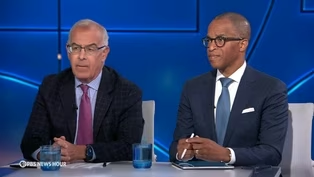
NewBrooks and Capehart on how the economy defined the primaries
Video has Closed Captions
Brooks and Capehart on how economic concerns defined the primaries (12m 7s)
 New
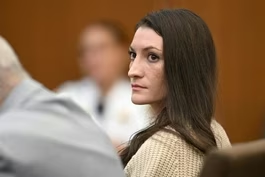
NewNews Wrap: Defense rests in murder trial of Lindsay Clancy
Video has Closed Captions
News Wrap: Defense rests in murder trial of Lindsay Clancy (6m 26s)
 New
NewParamount's threat to leave California divides Hollywood
Video has Closed Captions
Paramount's Warner Bros. bid and threat to leave California divide Hollywood (6m 36s)
 New
NewPoorna Jagannathan joins Amna Nawaz on 'Settle In'
Video has Closed Captions
Poorna Jagannathan and Amna Nawaz discuss representation in Hollywood on 'Settle In' (3m 44s)
 New
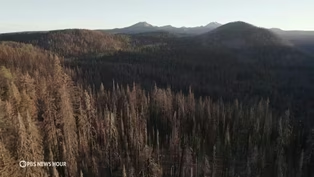
NewRecord amounts of glyphosate sprayed in California forests
Video has Closed Captions
U.S. Forest Service, timber companies spraying record amounts of glyphosate in California (9m 20s)
 New
NewTrump's ballroom gets boost from Supreme Court
Video has Closed Captions
From White House ballroom to IndyCar race, Trump's spectacles take center stage in D.C. (5m 55s)
 New
NewU.S. ambassador on tensions between Israel, Turkey, Syria
Video has Closed Captions
U.S. ambassador responds to rising tensions between Israel, Turkey and Syria (7m 52s)
Providing Support for PBS.org
Learn Moreabout PBS online sponsorship New Episode
- News and Public Affairs

Today's top journalists discuss Washington's current political events and public affairs.

- News and Public Affairs

FRONTLINE is investigative journalism that questions, explains and changes our world.
 New Episode
 New Episode
 New Episode
 New Episode

 New Episode
 New Episode
 New Episode
 New Episode
Support for PBS provided by:
Major corporate funding for the PBS News Hour is provided by BDO, BNSF, Consumer Cellular, American Cruise Lines, and Raymond James. Funding for the PBS NewsHour Weekend is provided by...