Here and Now
Here & Now for April 24, 2026
Season 2400 Episode 2441 | 26m 48sVideo has Closed Captions
Watch the entire episode of Here & Now for April 24.
Watch the entire episode of Here & Now for April 24.
Problems playing video? | Closed Captioning Feedback
Problems playing video? | Closed Captioning Feedback
Here and Now is a local public television program presented by PBS Wisconsin
Here and Now
Here & Now for April 24, 2026
Season 2400 Episode 2441 | 26m 48sVideo has Closed Captions
Watch the entire episode of Here & Now for April 24.
Problems playing video? | Closed Captioning Feedback
How to Watch Here and Now
Here and Now is available to stream on pbs.org and the free PBS App, available on iPhone, Apple TV, Android TV, Android smartphones, Amazon Fire TV, Amazon Fire Tablet, Roku, Samsung Smart TV, LG TV, and Vizio.
Providing Support for PBS.org
Learn Moreabout PBS online sponsorshipPBS Wisconsin Original production.
>> We want to do everything we can to make folks who have suffered those tragedies as whole as is possible.
>> Recovery efforts continue after cities and towns were buried under floodwaters and more tornadoes were recorded last week than the state typically sees in a year.
I'm Frederica Freyberg.
Tonight on "Here& Now", with some communities still underwater, we look at cleanup of the damage and if insurance will cover it.
Plus, a state climate report says this kind of extreme weather is here to stay.
[MUSIC] for refunds from tariffs deemed illegal, but it may not be that easy.
And we continue our coverage of the governor's race.
It's "Here& Now" for April 24th.
[MUSIC] >> Funding for "Here& Now" is provided by the Focus Fund for Journalism and Friends of PBS Wisconsin.
>> After a week of historic storms across the state, residents near the Wolf River in central Wisconsin were some of the hardest hit with flooding.
Some are just beginning to assess the damage after evacuation orders sent them fleeing to higher ground.
Beyond bailing out the water, many are calling their insurance companies to find out what damage is or isn't covered.
Here and now, reporter Steven Potter has this report from Waupaca County.
>> People were in kind of a panic because this rose faster and more water than we've ever seen in our lifetime.
>> When heavy storms struck central Wisconsin late last week, it was far too much for the Wolf River to handle.
A long waterway that bends through Waupaca County, many residents near the river, and even some not near the river, quickly found their homes and property underwater.
Communities like Fremont, New London and Shiocton were swamped.
>> It's worse than anybody anticipated.
>> Jim Falke is a village trustee in Fremont.
>> There's quite a few homes in the area that are severely damaged with waist deep water.
The businesses have all been shut down for for a week now.
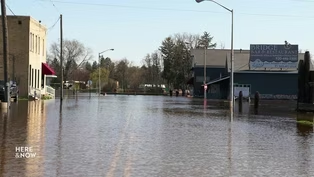
>> As you can see here in Fremont, much of downtown is flooded still days after.
We've got water pumps and trucks trying to get this water out.
One business owner told me they're simply trying to move water from one place to another.
Resident Yvonne Clemens owns two businesses in Fremont, one downtown and one on the river.
>> Of course, there's always been some high water, but I don't think anybody has ever expected to see it this high.
>> So as for her resort on the river, she says she doesn't know what's been ruined because it's so waterlogged she can't get to it.
>> Honestly, I have no idea.
I won't know until we see the extent of the damage and what needs to be replaced.
all the water and the damage, those affected by recent storms also have another challenge dealing with insurance companies.
>> It can be a very difficult time for people, right?
You have a storm come through.
You realize that your car is damaged, your house is damaged.
Maybe your your personal belongings are damaged and it can be scary.
You know, people don't necessarily know what to do, where to turn.
Wisconsin's insurance commissioner.
His office serves as the state's insurance industry watchdog.
>> We're here for people who have questions about dealing with their insurance policy, or for people who maybe feel like they're not being treated fairly.
have never encountered natural disasters before, he strongly recommends keeping good records in the aftermath.
>> Before you start cleaning up anything or spending money on any repairs.
Make sure you document the damage.
Take pictures.
Create an inventory of anything >> Houdek says people should resist the urge to move too fast during cleanup.
>> Before you make any major purchases or throw anything away, you really want to work with the adjuster to make sure that you're doing everything in complying with what you need to, to make sure that the claim is handled properly.
>> But what if your claim isn't being handled properly?
>> If you feel like your insurance company or the adjuster is not treating you fairly in terms of covering things that you feel like should be covered by your policy, that's when we encourage people to contact our office to, you know, potentially file a complaint or just to ask questions.
>> Houdek also notes that insurance policies vary widely and can be very different depending on the company and specific coverage.
It pays to read the fine print.
>> We encourage people to check their insurance coverage regularly to make sure that the coverage they have is appropriate and provides the necessary protection.
>> One very pertinent example of that is like what people in Waupaca County are going through right now.
>> If you have damage or you experience a loss from flooding that typically isn't covered by a homeowner's policy.
>> Houdek says that Wisconsin residents who actually have flood insurance are very few and far between.
>> Through the National Flood Insurance Program, there's only about 10,000 policies statewide.
And, you know, obviously we're a state of about 6 million >> But Houdek says flood insurance can be affordable and worth it.
>> A designated flood plain or in a place where you experience flooding regularly.
Really?
You want to consider getting flood insurance because we're seeing more and more situations where flooding is occurring in places where it really never has before.
Even one inch of water can cause as much as $25,000 of damage.
>> Roy Toepke is a lifelong Fremont resident.
>> I'm going to be 73 shortly and never been anything close to this as far as flooding.
>> He hadn't been back to his home since evacuation orders were given last Saturday.
He doesn't have flood insurance.
>> We have an exposed basement that I think may have had some water come in.
We'll find out when we get there.
We didn't really look into flood insurance because technically there's never been a flood where where we're at, but it might be something we need to look at in the future.
>> Worse than not having flood insurance is not having any insurance at all.
>> There is a lot of people on the river that do not have homes, homeowners insurance because of the cost or just because.
Yeah, they just don't have it.
>> Luckily, we do have flood insurance.
We have a call in to them, you know, to start the process.
Of course, it takes a while.
We also have regular insurance.
>> Those who may have insurance may not have enough or the right kind.
>> But you know, sometimes that doesn't cover lost wages.
So for those folks that have businesses that they rely on for income, it's going to be hard on those folks.
>> Early estimates on the water damage from last week's storms in central Wisconsin are already in the millions and continue to climb.
And that's not counting all of the time spent and tears already shed.
>> I think it's going to be a long haul before we're able to get it up and going again.
>> Reporting from Fremont.
I'm Steven Potter for here and Now.
>> Climate disasters like flooding and storms are on the rise across the state, resulting in added human and financial costs.
A new report projects we'll see more intense storms into the future and more rapid shifts between very wet and very hot conditions.
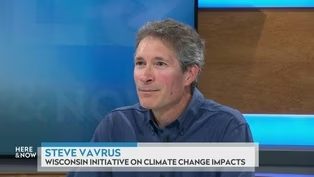
But there are ways to encourage climate resiliency, according to Steve Vavrus, co-director of the Wisconsin Initiative on Climate Change Impacts.
Just out with its 2026 assessment.
And thanks very much for being here.
>> Thank you for having me.
>> So are the current floods and last week's 24 tornadoes across the state, evidence of a changing climate?
>> I think last week's severe weather outbreak is a combination of random weather variability, i.e.
bad luck in this case, and also climate change.
And the climate change fingerprints are on it because climate change favors the warm, humid air masses that we saw out of season, we typically don't hit 80 degrees and have humid weather in the middle of April.
But if we do, we have the fuel that generates severe storms.
>> So according to your assessment, what are other trends for climate impacts going forward?
And some examples of that.
>> One of the the key terms or key phrases I like to use is warmer and wetter.
That describes the climate change we've seen to date, and also the climate change we're expecting in the future.
In Wisconsin, for example, the 2020s are currently the warmest decade in state history.
The 20 tens were the wettest decade in Wisconsin's history, and we've seen an increasing number of heavy rainfalls punctuated, unfortunately, with the state record last year.
Last summer in Milwaukee, dumping 14.5in.
>> And your report said something that stood out.
It was March used to be part of winter, but now it's part of spring.
>> Yeah.
And that's an interesting new finding that came out of the State Climatology office.
And the reason we talk about it that way is that in the past, starting in the most of the 20th century, the majority of time in Wisconsin, March was below freezing, below 32 degrees.
And recently in the past decade or so, that's flipped.
And now we spend the majority of March above freezing.
And that has big consequences in terms of whether we get rain or snow.
If we get snow, how long it sticks around, and when our lake ice melts in the spring.
very measurable.
And yet there is still, if not scientific political skepticism around climate change.
What is that like for a climate scientist?
>> More and more people understand that the climate's changing.
The evidence is all around us.
It's hard to miss the politics.
Enter into it in terms of how serious a problem it is compared with other issues that we're dealing with, and also what can we do about it, or what should we do about it, and how much resources should we put in terms of climate change and other other issues that we're facing?
So I think that the shifts there's been a shift in terms of how we talk about climate change, and the surveys show that increasing numbers of Americans understand and are aware of climate change.
>> Your report looks at ways Wisconsin can mitigate against the impacts like nature based strategies.
What's an example of that?
>> Yeah.
So we talk about in the wiki report, the wiki assessment, a range of options ranging from what we call traditional mitigation strategies, which is cutting carbon emissions, reducing the source of climate change to adaptation.
And that is accepting that there will be impacts.
And now figuring out what to do with it.
We try to promote nature based impacts.
These are things like green infrastructure.
Instead of relying strictly on traditional infrastructure.
So for instance, with more heavy rainfalls, the traditional engineering approach is to build bigger stormwater pipes, increase the size of culverts.
But there are also nature based green strategies such as rain gardens and green roofs, and bioswales and wetland restoration that can all be as effective or more effective, and also more reduce the costs as well.
>> How well does Wisconsin's infrastructure hold up to these changing climate impacts?
>> It's a mixed bag.
One of the ways that we're struggling right now is with these increasing numbers of extreme rainfall, because much of Wisconsin's infrastructure was built 40, 50, even 100 years ago, in some cases for a different climate.
And that climate was cooler and it was drier than the climate we're experiencing now.
And so certain ways that we used to manage stormwater just aren't valid anymore.
They aren't as effective.
And so the infrastructure can't hold up as well.
>> So is there a dollar figure on how much it would cost to make Wisconsin climate resilient infrastructure and otherwise?
dollar amount.
But I like to bring up the old adage that an ounce of prevention is worth a pound of cure.
And a lot of studies show that a dollar invested in becoming more resilient pays off many times over in terms of reduced damage.
And a good example of that was with Milwaukee becoming much more flood resilient over the years.
The Milwaukee Metropolitan Sewerage District in particular, has done a number of things that have made the city more resilient to climate change and heavy rainfalls, and the damage from last summer's rains would have been much, much worse without that.
>> All right.
Well, Steve Vavrus, thanks very much and thanks for your work.
>> Thank you.
>> The federal government is being forced to return more than $165 billion in collected tariffs to domestic importers and the online portal to request those refunds went live this week.
The U.S.
Supreme Court struck down President Trump's tariffs, resulting in the order to refund the import taxes.
Wisconsin businesses are looking to get some relief, including Viroqua based Wonderstate Coffee, with its three locations across the state.
CEO T.J.
Semanchin joins us now from Viroqua.
And thanks a lot for being here.
>> It's good to be here.
Thank you.
>> So first question, how much did tariffs cost you?
>> Yeah, we paid almost $140,000 in tariffs last year.
>> That's that's a that's a big number for any business.
But but in this tariff discussion is coffee unusual because it's almost all imported.
>> Yeah.
We have been saying this from the get go that we really didn't understand the purpose or the intent of taxing and tariffing a product that we can't even, you know, promote.
Domestic production of all coffee is grown in the tropics.
There's a tiny bit grown in Puerto Rico and Hawaii, but not close to being able to meet the U.S.
demand.
So we were, you know, paying a tax that we didn't even understand what the the impact was, was for.
>> So describe for me where you source your coffee from.
What country?
>> Yeah, we source a lot of coffee from Latin America, from places that people think about when coffee like Colombia, but also Peru, Guatemala, Honduras, Mexico, and then also in Africa.
We bring in a lot of coffee from Ethiopia, which is the birthplace of coffee, and also smaller countries like Rwanda and Burundi, Kenya.
>> What of the cost of the tariffs meant for your business?
>> Yeah, last year was really challenging.
It was unexpected.
You know, my 25 years in coffee, we've never even once considered a tariff on our coffee that we import.
So it was a curve ball.
And already in a challenging business climate where other costs are going up, like health care, shipping costs, things like that, that this was just one more headache.
And, and again, not being expected at all.
We had to deal with these costs.
One of the things that people don't quite realize is we, we had to pay for the tariff before we even got the product in the country.
So, you know, this is before we could even sell it, we had to borrow money to pay pay the tariff.
So we were then paying interest costs on, on the, the money we borrowed for the tariffs.
So all these things were compounding and just making it harder and harder for us.
>> Have you gone online to request a refund and if so, how is that process going?
>> Yeah, we technically are not the importer of record, so we work with brokers who do a lot of the logistics for us.
So their names are the ones that are on record for being the importer.
So we're working with them and they as, as one of their clients and they are, they're applying for those refunds.
And we haven't gotten any word of what the progress is or, you know, there's a lot of uncertainty on how this process is going to unfold.
>> To those tariffs, as significant as they were for a small business get passed along then to your customers.
>> Yeah.
In some way or fashion they did.
We had again, last year was challenging in a lot of ways.
Coffee itself, the cost, the commodity price of coffee skyrocketed last year.
So we were paying a tariff on what was already historical costs for for coffee.
So all these things were compounding.
And we did have a price increase last year that we passed on to our customers.
And tariffs were a part of that.
So the you know how much of that was the tariffs gets a little confusing.
And you know just because there was a lot of factors.
>> What has business planning been like over the course of these changeable tariffs.
>> We had to reforecast our profit and our budget last year.
We even pulled back on some investments in growth.
We decided not to buy a piece of equipment last year just because of the the business climate.
This would have been expanding our production capabilities.
And we, you know, this was a piece of equipment that the one that we're looking at was mostly built in Wisconsin.
So we we did not, you know, invest.
And we did not make that purchase.
So you could see even where the ripple effects might be.
But we did pull back on, on our kind of expectations for growth and profit and even hiring and being able to invest in our staff that, you know, coming into 2026 with the change in tariffs.
And it feels like, you know, we we are a little more optimistic kind of going, we're going back a whole year where we kind of came into 2025.
We're kind of coming back into 2026 with that perspective.
But I would say that it felt like a whole year of just kind of a holding pattern.
>> How optimistic are you that you will get the tariffs that you paid refunded?
>> I'm a pretty optimistic person, so I put our chances at better than 50%.
But again, I'll believe it when the money is in our bank.
Because again, this has been such a uncertain process from the beginning.
We're hoping that the administration doesn't fight as the, you know, as this portal is open and money starts flowing, that they don't cut off those funds.
But we don't, you know, we don't know.
We're not we're not counting on it until we actually have the money in our bank, which might be months, months or a year from now.
We don't know.
TJ Semanchin, thanks very much.
>> The burgeoning interest in sports related prediction markets over the last few years has led to platforms like Kalshi and Polymarket to trade in billions of dollars annually and wanting to cash in on Wisconsin customers.
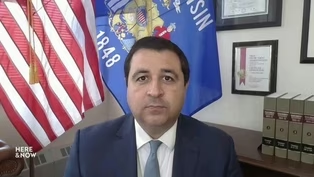
But State Attorney General Josh Carl this week filed a lawsuit against these and other similar platforms, saying they may use new terminology, but they are still violating Wisconsin gambling laws.
>> The platforms where this is taking place are known as prediction markets.
And what we allege is that the way these companies have framed this is that you can, on those prediction markets, purchase what they what they call an event contract.
And what we allege here is that the the event contracts on sporting events are indistinguishable legally or practically for that matter, from sports betting and constitute sports betting under Wisconsin law.
>> Anyone who has thought about buying or selling a house recently knows prices are up, interest rates remain higher, and more people seem to be locked out of owning a home.
In our continuing series, looking at the biggest issues in the race for governor "Here& Now", senior political reporter Zac Schultz asked the candidates for governor about what the state should do to help fix the affordable housing crisis.
>> A 2024 study by the Wisconsin Policy Forum showed.
Over a five year stretch, home prices went up 53% while incomes rose by less than 20%.
State government can't lower the price of materials or labor, but it can create an environment making it easier to build new homes.
So we asked the candidates for governor how they plan to address the affordable housing crisis in Wisconsin.
>> So the plan to increase affordable housing is to ensure that we put a stop on corporate monopolies that are buying up wholesale properties.
This is going on in Milwaukee.
These these monopolies are making it difficult for first time homeowners.
These monopolies are making it easy or, excuse me, making it more difficult for people to be able to afford rent because if they own all the properties they can, they can price people out or just charge whatever they want to charge.
And where else are people going to go?
>> We need to look at it as a three legged stool.
There is the legislation that we have to make sure that we have laws that allow us to build affordable housing.
rules and making sure, like, you know, how you can build what type of permits that you need.
And then there's funding.
And right now, there is nobody who is looking at all three of those things to make sure that they're aligned.
So as governor, I would assign somebody to make sure that they are looking at housing overall, having a statewide strategic plan to make sure that we have some of those starter homes that we certainly don't have in Wisconsin anymore.
>> Housing is a is a vexing problem, but it is not insurmountable.
And what we've seen at WEDC, the work that we did was to support innovative housing, housing, whether it's bringing a nursing home into housing, a nursing home that's closed in Gilman, we were able to support making that into apartments or schools that have closed due to lack of population, turning those into housing.
But we are also seeing new housing being built.
And so what I would want to do is make sure that local communities have the resources they need to provide the infrastructure, the water, the sewer for new housing, but then also making sure that we're supporting developers all around the state as they make the move to build housing.
>> We have to have a multi-pronged approach, and we have to make it easier to build housing and look at different avenues and innovative ways to ensure that we have permanent affordability when it comes to housing.
I'm interested in looking at community land trusts about how we can provide better zoning regulations and the ability to build ADUs and ensure that we have spaces for some folks who may no longer need to be in their homes.
Where there can be starter homes for folks who are moving into communities and looking at diversifying our housing stock for folks who are moving or maybe downsizing.
>> Wisconsin likely needs a top to bottom housing plan where we can look at all aspects of this, and there are tools at our disposal that we have through Wida that I'm not sure that we are using to the best of our abilities.
And if we need new tools, we'll go out and get them.
But this is kind of the core of affordability for Wisconsin families, is ensuring that they have a safe and secure place to put a roof over their head, that they can build equity, that they can build wealth for their family over time.
So that's one of the issues that I look forward to working on as soon as I become governor.
>> Well, first of all, we need to get control of property taxes.
At a minimum, freeze them.
I would get rid of the 400 year property tax increase, but I think we can do a lot of it via regulatory reform.
And I refer to it as a red tape review.
You look at the state of Virginia, they did something like this, and they reduced their regulations largely by by about 25%.
They reduced the cost of building a new home by about $24,000.
We've seen studies by the Wisconsin Institute for Law and Liberty, where they've said as much as $80,000 goes in to the cost of a new home.
That has nothing to do with building materials.
So I think we can get control of some of that by reducing duplication in regulations.
>> It's important to understand that there isn't a one size solution that fits all of the problems that we're facing as a state.
What works in Milwaukee may not work in Menasha, may not work in Marinette, may not work in Barron.
And so we have to make sure that we're working with those local organizations, those local units of government, to figure out what right size solution works for them.
Yes.
Do we need more affordable housing?
Absolutely we do.
We need that for our seniors, for working families, for people with disabilities.
But we also need attainable housing as well.
And attainable housing is those who have the ability to afford those who may not qualify for affordable housing, but have the means to buy their own home.
Yet we don't have the housing stock.
doing more to incent development projects, helping local governments make zoning changes to allow for more housing to be built, and to allow more flexibility in how we use our dollars so that we can actually get more bang for our buck in terms of building new housing.
But ultimately, this is really a supply and demand problem.
We have too much need for housing and not enough houses being built, and it's been that way for since the Bush recession.
We've underbuilt housing and now we're really reaping the consequences.
So we just have to get more housing online quickly.
>> Reporting from Madison.
I'm Zac Schultz for "Here& Now".
>> For more on this and other issues facing Wisconsin, visit our website at PBS wisconsin.org and then click on the news tab.
That's our program for tonight.
I'm Frederica Freyberg.
Have a good weekend.
>> Funding for "Here& Now" is provided by the Focus Fund for journalism and friends of PBS Wisconsin.
 New
NewHere & Now opening for April 24, 2026
Video has Closed Captions
Clip: S2400 Ep2441 | 1m 15s | The introduction to the April 24, 2026 episode of Here & Now. (1m 15s)
 New
NewSteve Vavrus on Wisconsin's Rising Risk for Extreme Weather
Video has Closed Captions
Clip: S2400 Ep2441 | 5m 34s | Steve Vavrus on a growing level of extreme weather and actions to safeguard against risks. (5m 34s)
 New
NewTJ Semachin on Importing Coffee and Pursuing Tariff Refunds
Video has Closed Captions
Clip: S2400 Ep2441 | 6m 22s | TJ Semachin on how tariffs have affected his business and the system to apply for refunds. (6m 22s)
 New
NewWisconsin Files Suit Against Prediction Market Businesses
Video has Closed Captions
Clip: S2400 Ep2441 | 59s | Wisconsin is suing prediction markets for serving as platforms for illegal sports betting. (59s)
 New
NewWolf River Communities Deal with Flooding — and Insurance
Video has Closed Captions
Clip: S2400 Ep2441 | 5m 53s | Residents who live near the Wolf River are dealing with the aftermath of historic floods. (5m 53s)
 New
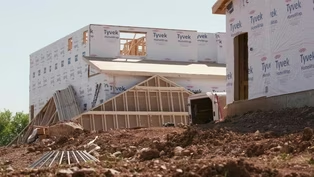
NewWisconsin's 2026 Governor Candidates on the Cost of Housing
Video has Closed Captions
Clip: S2400 Ep2441 | 6m 5s | Candidates in the 2026 race for governor on the high cost and limited supply of housing. (6m 5s)
Providing Support for PBS.org
Learn Moreabout PBS online sponsorship
- News and Public Affairs

Top journalists deliver compelling original analysis of the hour's headlines.

- News and Public Affairs

FRONTLINE is investigative journalism that questions, explains and changes our world.












Support for PBS provided by:
Here and Now is a local public television program presented by PBS Wisconsin