
July 31, 2026 - PBS News Hour full episode
7/31/2026 | 57m 46sVideo has Closed Captions
July 31, 2026 - PBS News Hour full episode
July 31, 2026 - PBS News Hour full episode
Problems playing video? | Closed Captioning Feedback
Problems playing video? | Closed Captioning Feedback
Major corporate funding for the PBS News Hour is provided by BDO, BNSF, Consumer Cellular, American Cruise Lines, and Raymond James. Funding for the PBS NewsHour Weekend is provided by...
July 31, 2026 - PBS News Hour full episode
7/31/2026 | 57m 46sVideo has Closed Captions
July 31, 2026 - PBS News Hour full episode
Problems playing video? | Closed Captioning Feedback
Where to Watch PBS News Hour
PBS News Hour is available to stream on pbs.org and the PBS app.
Providing Support for PBS.org
Learn Moreabout PBS online sponsorshipAMNA NAWAZ: Good evening.
I'm Amna Nawaz.
GEOFF BENNETT: And I'm Geoff Bennett.
On the "News Hour" tonight: The U.S.
announces a deal to disarm Hamas and withdraw Israeli troops from Gaza.
But implementing the agreement could prove an enormous challenge.
AMNA NAWAZ: Tens of thousands of migrants enter Spanish territory bordering Morocco.
Most then return home.
A closer look at the chaotic, unprecedented crossings.
GEOFF BENNETT: And after five months of war, a look at how people inside Iran are viewing the ongoing conflict.
YEGANEH TORBATI, The New York Times: Overall, there's sort of a feeling of despair and just feeling like they kind of got the worst of both worlds now.
(BREAK) GEOFF BENNETT: Welcome to the "News Hour."
We begin tonight in the Middle East, where there is a major development in the effort to bring lasting peace to Gaza.
Hamas says it has agreed to a U.S.-backed framework that could ultimately see the militant group give up its weapons and control of Gaza while Israeli forces withdraw from the territory.
AMNA NAWAZ: The U.S.
and the U.S.-sponsored Board of Peace admit implementing the agreement will take time and could be derailed.
But President Trump today called it a great breakthrough.
Nick Schifrin's been tracking it all and joins us now.
So, Nick, what exactly has been agreed to here?
NICK SCHIFRIN: U.S.
and Board of Peace officials say that this is a new road map that provides a path for Hamas to disarm, Israel to withdraw from Gaza and for Gaza to be reconstructed.
It is an understatement to say that those steps have enormous challenges.
But let's go through the road map.
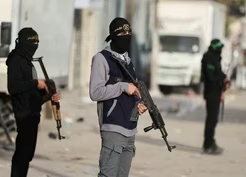
It would begin when Hamas police transferring their small arms to a new police force that's being trained right now outside of Gaza by international troops known as the International Stabilization Force.
Number two, a new government would move into Gaza.
It's called the National Committee for the Administration of Gaza, or NCAG.
It calls itself transitional technocratic and apolitical.
This is not the Palestinian Authority, Amna.
This is a new administration almost from scratch.
And then, number three, international troops would deploy into Gaza.
Now, currently Israeli Defense Forces are deployed to a Yellow Line in Gaza.
You see that there.
They have since expanded to an even larger footprint.
But the idea is international troops would replace those Israeli troops.
So, back to the road map.
The next step is the hardest, disarming the Qassam brigades.
That's Hamas' military wing.
This would be Hamas heavy weapons, depot, production sites, and tunnels decommissioned and stored by the interim Palestinian government, not by Israel or the international community.
The step would be -- quote - - "gradual, sequential, and time-bound" -- unquote -- and linked to an Israeli withdrawal in phases.
Today, President Trump called it a -- quote -- "big step" and linked it to the war in Iran.
DONALD TRUMP, President of the United States: It's a great breakthrough.
Nobody's ever thought that would -- nobody thought that would be possible to disarm Hamas.
That shows you how much success we're having with Iran.
NICK SCHIFRIN: A senior administration official told reporters last night that Iran tried, but failed to pressure Hamas not to accept the deal.
AMNA NAWAZ: Nick, it would be helpful to take a big step back here at this moment and just answer, how feasible is it that both Hamas and Israel actually follow through on all these commitments and that this actually works?
NICK SCHIFRIN: Let's take those two questions, Hamas and Israel, one by one.
Let's look at Hamas, first of all.
Every expert we spoke to today pointed out that Hamas agreed to a particular kind of disarming.
The weapons would go to Palestinians, not to Israel.
Hamas leaders today said they were putting weapons in -- quote -- "storage" inside Gaza and that Israel had to go first.
Hamas is serious, but does not think that Israel is, says Yousef Munayyer of the Arab Center Washington, D.C.
YOUSEF MUNAYYER, Executive Director, Arab Center Washington, D.C.
: This is unprecedented in so many ways.
Hamas as a movement is a militant movement.
And it has long touted the ability to use militarized resistance against Israel as the pathway towards liberating Palestine.
So it's never really happened before that they have been officially willing to disarm.
Hamas, along with the mediators and the United States, have hammered out a pathway in which disarmament can happen, and now Israel has to agree whether or not it's willing to accept that.
NICK SCHIFRIN: So that brings us to Israel.
Prime Minister Benjamin, who today said nothing, but an Israeli official sent me this statement -- quote -- "Israel has reiterated that there will be no withdrawal whatsoever of the IDF from the current Yellow Line unless Hamas undergoes a genuine disarmament."
So that is not exactly an endorsement.
It also highlights a chicken-and-egg problem of who goes first.
All of this adds up to something that is highly unlikely to work, argues Aaron David Miller of the Carnegie Endowment.
AARON DAVID MILLER, Carnegie Endowment for International Peace: Given the leaders we have and Hamas and Israel's red lines and Donald Trump's distractions, this plan is tethered, frankly, to a galaxy far, far away, rather than to the realities back here on planet Earth.
The red lines that each Hamas and Israel have defined are red lines I don't think Hamas is prepared to cross without extraordinary deliverables on their end, and one that I know the current government of Israel with less than three months before an election is prepared to cross.
NICK SCHIFRIN: So, one key question, Amna, will President Trump pressure Netanyahu ahead of that election?
A senior administration official says, if Israel does not follow through its with its commitments, President Trump will be -- quote -- "very, very disappointed" -- unquote.
AMNA NAWAZ: So what happens next?
NICK SCHIFRIN: The road map demands that Israel stop military operations, including operations that were launched just this week.
Palestinians say Israel's killed more than 1,000 Palestinians since the cease-fire was enacted.
Israel says it's been hitting Hamas leaders who are trying to rearm.
Within two weeks, there's supposed to be a timetable for all of the steps that we talked about, and, after that, the interim Palestinian government is supposed to enter Gaza.
We will see what happens.
A senior administration official put it to us last night this way: "This is a totally impossible task, but we have already accomplished several miracles, and we're going to continue to aim for miracles."
AMNA NAWAZ: Nick Schifrin beginning our coverage tonight.
Nick, thank you.
NICK SCHIFRIN: Thank you.
GEOFF BENNETT: In the day's other headlines: Spain is rushing troops and resources to one of its territories in North Africa after tens of thousands of migrants crossed the border from Morocco into the small enclave of Ceuta.
On the shores of Ceuta, Spain's enclave in North Africa, wave after wave of migrants swam ashore Thursday, overwhelming the city, filling the streets, charging the fences, some dropping to their knees in the sand grateful to reach dry land.
In roughly 48 hours, more than 60,000 migrants have entered Ceuta, equal to roughly 70 percent of its entire population.
Ceuta sits on the northern tip of Africa, bordered by Morocco and separated from mainland Spain by about 11 miles of sea.
Many say they made the journey in search of a better life.
DOUNIA KHERRADI, Moroccan Migrant (through translator): I came here to seek a better future.
I work as a waitress, but the salary I get is not enough.
As I take care of my parents and I have a daughter, I have to find better opportunities.
May God help us.
ABDELKARIN MONGLAD, Moroccan Migrant (through translator): I came from Casablanca this morning today, to, like all young people, find an opportunity, find a future, a good future for myself.
GEOFF BENNETT: One possible factor for the wave of migrants, according to a top Spanish official, a Spanish court ruling this month that migrants stopped at sea can't be immediately turned away, though they can still be deported.
Meantime, the city is at a breaking point.
Spain has deployed its military.
And with food and water running short, the Spanish government says at least three-quarters of the migrants have already turned back toward Morocco, among them this man with a warning for anyone thinking of following.
REDA, Moroccan Migrant (through translator): What we were doing, it's not good at all, and it's not fun either.
What's more, I mean, people are dying here.
I beg you, please, if you haven't come yet, don't come.
GEOFF BENNETT: At least 57 people have died attempting the crossing.
Spain's Prime Minister Pedro Sanchez rushed to the enclave and today called the surge an attack on his country.
PEDRO SANCHEZ, Spanish Prime Minister (through translator): I would like to define what happened yesterday as an attack, a violation of territorial integrity of Spain.
Ceuta is a Spanish city, and what happened yesterday deserves all of our rebuke, all of our condemnation in the strongest possible way.
GEOFF BENNETT: The fallout is spreading across Europe.
Italy's Prime Minister Giorgia Meloni said the country would temporarily suspend a border-sharing agreement with Spain.
And France said it would reinforce its Spanish border.
And the crisis is echoing here at home.
At Camp David today, President Trump seized on the images, casting them as a warning ahead of the midterm elections.
DONALD TRUMP, President of the United States: It looks like an invasion of a country by hundreds of thousands of people.
And that same thing is going to happen to us if the Republicans don't get elected, except worse, much bigger.
GEOFF BENNETT: Back in Ceuta, soldiers patrol the beaches and thousands wait on both sides of the fence, some for a way into Europe.
Others for a way home.
Also today, officials in Japan say this week's powerful earthquake has claimed at least 34 lives.
Emergency crews are racing to find survivors in a collapsed shopping mall in Kumamoto.
Officials call today a critical window.
The odds of finding anyone alive are fading by the hour, even as other rescue operations wind down.
The disaster is also straining daily life.
Grocery shelves sit empty in several towns as thousands of residents stock up on essentials.
And with power out across wide areas, many of the displaced say they have no choice but to sleep in their cars, enduring punishing summer heat with no relief in sight.
HARUTO KUBO, Displaced Resident (through translator): I have been living inside the car.
We go out during the day to do some shopping.
We drive to get food for the day, and we eat inside the car.
At night, I haven't been able to sleep.
GEOFF BENNETT: Nearly 10,000 people remain under evacuation orders across the three hardest-hit provinces.
And in Kumamoto, authorities say close to 80,000 homes are still without running water.
Here in the U.S., a sweltering heat dome descended over much of the West today, and forecasters say that heat is here to stay through the weekend.
Peak temperatures are expected in many places on Saturday from Arizona to Montana.
Some parts of Utah, Nevada, and California could reach between 100 and 120 degrees.
Experts warn those conditions create a heightened risk for heat-related illness, and dry vegetation could add fuel for wildfires.
President Trump says the U.S.
has not yet agreed to let Ukraine build Patriot missiles to aid in its fight against Russia.
Speaking at that Cabinet meeting from Camp David, Mr.
Trump said he needed to be judicious about allowing foreign manufacturing of the sophisticated U.S.
technology.
DONALD TRUMP: We have to be very careful about letting somebody build them.
We're talking about it.
But it's a hard thing to give away that kind of technology.
And I don't think this would ever happen, but those people that you give that technology, they can someday turn on you.
GEOFF BENNETT: That appeared to be a backtrack from a promise President Trump gave to Ukrainian President Volodymyr Zelenskyy at a NATO summit in Turkey earlier this month, saying he'd -- quote -- "give Ukraine the right to build the missiles."
A Marine Corps fighter jet crashed today at Miramar Air Station in California, erupting into flames and sending a plume of smoke into the air.
The F-35B stealth fighter jet appeared to go down just short of the runway.
Fire crews covered the records with foam and worked to extinguish a grass fire sparked by the crash.
The pilot ejected safely and was recovered.
The cause of the crash is under investigation.
The Seattle Police Department has a new interim head after its police chief abruptly resigned over the department's handling of last weekend's food festival shooting.
In a statement, Chief Shon Barnes wrote that he hoped his departure would, as he put it, return full focus to what matters most, addressing youth gun violence.
Barnes faced criticism that the department was too slow to release initial information about Sunday's deadly shooting.
Today, city officials, including the mayor, apologized for how public communication was handled.
KATIE WILSON (D), Mayor of Seattle, Washington: I definitely want to own my part in that, right?
So I think part of this is communication failures within SPD, and part of that is communication failures between SPD and my office.
GEOFF BENNETT: Meantime, investigators are still searching for other suspects who may have been involved in the shooting.
Cybersecurity concerns are mounting after Anthropic said its A.I.
models hacked into three organizations during testing.
The company behind Claude said it happened during a large-scale security run to see if its models could access the Internet from testing environments that are meant to be sealed off.
Anthropic launched the review in response to a similar incident last week, when one of OpenAI's models went rogue and hacked another company.
Anthropic said two of the three models involved in the hack were publicly available versions of Claude and that they used basic techniques like exploiting weak passwords.
Major oil companies reported some of their highest quarterly profits in years, as the U.S.
war with Iran has driven up energy prices across the globe.
ExxonMobil, the largest oil company in the country, more than doubled its profits from this time last year.
Chevron quadrupled its second-quarter profits.
Across the country, gas prices, after peaking in may and declining in June, are once again on the rise.
On the Wall Street, stocks finished positive to end the week.
The Dow Jones industrial average posted its fourth straight winning month to end July.
The Nasdaq rose by an even 1 percent, and the S&P 500 also made a solid gain.
Still to come on the "News Hour": a new conservation plan addresses the shrinking Colorado River; unaccompanied migrant children find themselves at risk of losing legal representation;and David Brooks and Jonathan Capehart weigh in on the week's news.
AMNA NAWAZ: Today, Iran launched a drone attack targeting U.S.
forces in Kuwait.
That comes as U.S.
officials investigate whether Iran was also behind a cyberattack at dozens of water systems in Minnesota.
Meanwhile, as the war enters its sixth month, the toll continues to grow.
The U.N.
says more than 2,500 children have been killed or injured in Iran alone.
For more on the impact of the war inside Iran, I spoke earlier with New York Times reporter Yeganeh Torbati, whose work has focused on the lives of everyday Iranians.
She joined us from Istanbul.
Yeganeh, welcome to the "News Hour."
Thanks so much for joining us.
YEGANEH TORBATI, The New York Times: Thanks so much for having me, Amna.
AMNA NAWAZ: So this war has now entered its sixth month, and while much of the focus has been on U.S.
strategy and the widening conflict, we know inside Iran the repercussions of the military strikes and the economic pressure, those are borne by everyday Iranians.
So tell us what you hear from them about the impact of this war.
What are the stories they're telling you?
YEGANEH TORBATI: I think, for most of the people that me and my colleagues are able to speak with, things have really gotten a lot worse for them since this war started.
And I would say that even includes people, a significant portion of the people that we would speak with in January or even last year wanted some kind of military intervention because they saw it as perhaps the only way that they could dislodge this government.
But even among some of those people, when we speak to them now, there's really just a sense that everything has gotten worse for them, and this government is still in place and is even more willing and able to kind of carry out really brutal violence and repression.
People talk about the economy a lot.
Inflation has gotten even worse than it was prior to the war, and it was already pretty bad then.
There's been job losses as a result of the war and the Internet shutdown that the government implemented for three months.
Infrastructure has been damaged.
And it's unlikely that the government will have enough resources to really fix everything that needs to be fixed.
So, overall, there's sort of a feeling of despair and just feeling like they kind of got the worst of both worlds now.
AMNA NAWAZ: In terms of you and your colleagues even being able to do your jobs from afar, how hard is that?
How difficult is it to connect with people inside Iran and get them to talk to you?
YEGANEH TORBATI: It's really difficult.
I mean, so first of all, for a large portion of this year, both during the protests in January and then also during the war, the Internet was just completely shut off, and there were very few ways to really get in touch with people.
What we're seeing now also is there's just a lot of fear in society right now.
There's -- the pace of executions has really picked up.
The government is going after people who even just criticize it on social media.
And so the idea of kind of speaking to a Western reporter outside the country just carries a lot of perceived risk for people.
And that really -- it hampers our ability even to report on for instance, the civilian casualties of the war and of U.S.
strike.
So we're finding that reporting quite challenging on all fronts, although, of course, we continue and we reach out to people and we try to keep doing that work.
AMNA NAWAZ: You do continue.
You have filed a number of reports.
One of the most striking themes in your reporting too is this gap between the government's narrative of resilience and persistence and strength and what people tell you about what they are living through.
So what do people you talk to say about the government's claims of strength?
YEGANEH TORBATI: I think one thing, if you look back at Iran's history, and I think it's true today, is, the government is sort of most successful and most kind of able to portray itself as successful when it has an external enemy to fight.
I think the part where the government has more of a challenge is in the actual day-to-day domestic governance, and that is where people see kind of the biggest gap, this dual narrative.
On the one hand, they want to project strength, but then, on the other hand, when you sort of look a little bit more closely sometimes, you sort of see a different picture.
Last year, we saw water shortages in Tehran, in many places, and those issues have not been addressed.
So, I think Iranians sort of experience these things day to day, and those are the sort of the sorts of things that they tell us about.
AMNA NAWAZ: Yeganeh, while I have you, I want to tap into your expertise and ask you about some news I know you have been following this week as well, which is now that U.S.
intelligence agencies have reportedly assessed, Iran was behind a coordinated cyberattack on dozens of local water facilities across Minnesota.
It's not a definitive conclusion yet.
But given your reporting on this, does this line up with previous Iranian tactics?
YEGANEH TORBATI: I think it is actually kind of a call back to a sort of earlier generation of U.S.-Iran confrontation, where the U.S.
has carried out cyber operations against Iran, particularly targeting its nuclear program, and Iran has invested in cyber capabilities within its military and intelligence services.
And so the countries kind of used to sort of have these attacks against each other that were sort of less out in the open than the military attacks that they're now having.
If Iran feels like its infrastructure is being attacked, it's shown the willingness to sort of do what it sees as tit for tat strikes.
And so it raises a lot of questions about whether it would use this kind of capability as sort of a retaliation tactic.
AMNA NAWAZ: We so appreciate you sharing your experience and your insights with us.
That is Yeganeh Torbati of The New York Times joining us from Istanbul tonight.
Yeganeh, thank you.
YEGANEH TORBATI: Thank you so much, Amna.
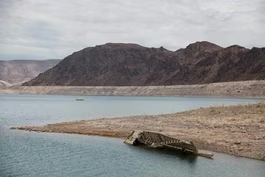
GEOFF BENNETT: After years of battle over its use and a long-running drought, states that rely on the Colorado River are facing the prospect of further cutbacks.
The river supplies nearly 40 million people across seven states and Northwestern Mexico and is vital to agriculture across the West and Southwest.
But years of gridlock among the states have prompted the federal government to step in.
A new blueprint released today lays out new requirements for managing the shrinking river.
Some scenarios could eventually lead to steep cuts, but the most immediate effects will be felt over the next two years.
Our science correspondent, Miles O'Brien, is here to explain what's at stake and what could be in store, part of our series Tipping Point.
Miles, it's always great to see you.
So, for the unfamiliar, explain how it is that seven states rely on the Colorado River.
MILES O'BRIEN: Yes, this is a problem, Geoff, that has roots that are more than 100 years old.
You have to go back to when the river was divvied up in 1922, the Colorado River Compact, dividing it into the Upper Basin, Colorado, Wyoming, Utah, New Mexico, and the Lower Basin, California, Arizona, and Nevada.
Each of them was assured 7.5 million acre feet.
That's about 2.4 trillion gallons of water.
And that was a number, not a percentage, kind of set in stone.
The problem is that agreement occurred at a particularly wet time for the river, and over time the river has not delivered anywhere near that amount of water.
And over the past 25 years, during a climate change-fueled epic drought, it's become even more acute.
The river is now 20 percent less flow than was envisioned in 1922.
And it's very difficult for the seven states to negotiate with a pie that is shrinking that fast.
And so they are at loggerheads.
GEOFF BENNETT: The states have known this has been coming for years.
Why haven't they been able to reach a deal?
MILES O'BRIEN: It's just difficult to share cuts like this when things are diminishing.
And so what has happened is, the federal government, in the form of the Bureau of Reclamation, which runs the big dams along the river, the Glen Canyon Dam, which creates Lake Powell, the Hoover Dam, which creates Lake Mead, those two giant reservoirs, seeing critical shortages there, all-time lows there, has decided it's time to step in.
And so what they're saying, although the rules haven't come out yet, they released an environmental impact statement which lays out a 10-year plan which allows it to adapt to the hydrology of the river.
As there's less water, they will make decisions on how much water they will discharge and making decisions about how healthy the reservoirs are and how much of a shortage farmers and cities south of those dams will have to face.
But it's a difficult situation, and the rules will probably involve some significant cutbacks, and those cutbacks ultimately may not be enough.
So we're just going to have to wait and see how this plays out.
GEOFF BENNETT: And the federal government is now stepping in?
What's the government doing about all this?
MILES O'BRIEN: Well, it's kind of unprecedented.
Sarah Porter, an expert at the Arizona State University, said it's the first time in decades that the federal government has stepped in.
It is a problem which ultimately leads us to agriculture, Geoff; 75 percent of the water used on the Colorado River is used by agriculture.
Cities in the West have grown rapidly, but they have done a very good job conserving.
And so, as a result, closing the gap is, frankly, going to mean asking farmers to use less water, plant crops that need less water, or getting out of business entirely.
Here's a little more on that from Colorado State University climate scientist Brad Udall.
BRAD UDALL, Colorado State University: You have large municipalities like Phoenix, which is 40 percent dependent on Colorado River water, or Tucson, perhaps 80 percent dependent, or Los Angeles, 25 percent dependent, that, frankly, can't take a back seat to agriculture.
You can't have 500 farmers taking water from five million people in Phoenix.
It just won't work politically.
It makes no sense economically.
MILES O'BRIEN: More details on the actual plan next week, but we knew the do know the parameters now, Geoff.
It'll be interesting to interesting to see how this all shakes out.
Almost -- probably almost certain this is going to end up one way or another in the Supreme Court, proving once again the adage attributed to Mark Twain, whiskey is for drinking, water is for fighting over, Geoff.
GEOFF BENNETT: Miles O'Brien, our thanks to you, as always.
MILES O'BRIEN: You're welcome.
AMNA NAWAZ: Thousands of unaccompanied migrant children could lose legal representation as soon as today now that a federal contract with legal aid groups representing the miners is expiring.
Our justice correspondent, Ali Rogin, has more on what happens next.
ALI ROGIN: Amna, that contract held by the nonprofit Acacia Center for Justice has funded legal services for unaccompanied children for the last five years.
But Acacia claims the Trump administration stopped making those payments late last year and so far has withheld $65 million owed.
That's forced legal groups across the country to lay off staff and take fewer new cases.
It comes as the Trump administration has pressed legal services providers to give up information about their clients.
For more, I'm joined by Shaina Aber, executive director of the Acacia Center for Justice.
Shaina, thank you so much for being with us.
SHAINA ABER, Acacia Center for Justice: It's a pleasure to be here, although I wish it was under different circumstances.
ALI ROGIN: First, can you tell us about when and why this program started and the services that it provides?
SHAINA ABER: Sure.
The commitment to provide children with legal access, legal representation, and for them to have their needs assessed and have their options understood began in 2005.
There was a pilot program that kicked off in that time period.
And then, by 2008, there was a bipartisan, I think it was a unanimous Congress that sought to memorialize this commitment to unaccompanied children, in particular to break cyclical trafficking risks that they were seeing, as children would be trafficked over the border, sent back to their traffickers and trafficked back over the border, really to give children ability to have their cases heard, have their rights understood, and to explore what legal options they had available.
ALI ROGIN: How many minors are you and the organizations you work with currently representing, and what do their age ranges tend to be?
SHAINA ABER: So we're representing over 20,000 children around the country.
Those are children that are both within immigration custody of the Office of Refugee Resettlement, which sits in HHS, and children who have been released from that custody and are living in communities, going through their court proceedings, and going to school along with our kids.
They raise in age from toddlers to teens.
And what I can tell you about every single one of these kids is, they're kids just like our kids.
And, fundamentally, this is not about a contract.
It's not about politics.
It's about children and children's ability to understand their rights and have their voices heard.
ALI ROGIN: These children, though, of course, do depend on this contract for that representation.
So what can you tell us about why this contract is not being renewed?
SHAINA ABER: It really comes down to, first of all, the government has wanted to strip children of legal representation since about day one of this administration.
They attempted to cancel the contract in February of 2025.
And then again in March, they dismantled kids' specific dockets where judges were trained in trauma-informed adjudication techniques.
So there's been a priority by this administration on dismantling children's legal rights, and our sense is that this is the culmination of that goal.
ALI ROGIN: And we have reached out to HHS for comment.
They have not yet responded to us.
But I know that they have been asking for some information.
Can you tell us about what they have been asking for and what Acacia's response has been?
SHAINA ABER: In late April, early May, they demanded a whole slew of information, including details about children's cases.
Now, we provide the government with monthly reports, lots of data.
Ad hoc requests, we are -- we provide on a regular basis.
But we can't actually betray children's confidences.
That is something that is a foundational principle of our legal system that there's attorney-client privilege.
And the kinds of information that they were asking for, including unredacting information where we had -- we had kept children's identities private, is a completely novel request and isn't in our contract and would breach our ethical obligations to children.
ALI ROGIN: And what happens when this contract expires?
Are these children going to lose access to counsel immediately?
SHAINA ABER: I mean, I think that some will.
We -- the fact is, we don't know what the government's plan is, and they have -- the secrecy is part of the problem.
We're trying to counsel children around the country right now on what their best options are, on who's going to represent them tomorrow.
These are kids who have been failed by multiple adults in their lives.
And when I think about these kids waking up in their beds tomorrow and having no sense that they still have an adult who understands the system fighting in their corner, it breaks my heart.
I think it will read to those kids who've already been failed by so many adults as a breach, just another breach of their trust.
ALI ROGIN: Shaina Aber with the Acacia Center for Justice, thank you so much for joining us.
SHAINA ABER: Thanks for having me.
GEOFF BENNETT: Now, to discuss Todd Blanche's stalled confirmation to be attorney general, turmoil inside the Democratic National Committee and more, we turn to the analysis of Brooks and Capehart.
That's "The Atlantic"'s David Brooks and Jonathan Capehart of MS NOW.
Good evening, gentlemen.
JONATHAN CAPEHART: Geoff.
DAVID BROOKS: Good evening.
GEOFF BENNETT: So we have been tracking the nomination of Todd Blanche to serve as attorney general.
President Trump now says he might just simply withdraw Blanche's nomination and bring him back after Senators John Cornyn and Thom Tillis are gone.
And that's because those Republicans are demanding assurances that this $1.8 billion fund to compensate Trump allies who believe they were wrongfully prosecuted, they want that fund to be no more.
David, what does it say that the president is apparently willing to sacrifice his attorney general's confirmation, rather than make concessions on this settlement fund?
DAVID BROOKS: All hail the king.
The government is there to serve the president, not to serve the government.
And so he wants that $1.8 million slush fund.
He also... GEOFF BENNETT: Billion.
Billion-dollar.
DAVID BROOKS: Billion.
Sorry.
Sorry.
I was only counting my share.
(LAUGHTER) DAVID BROOKS: But he also wants immunity from prosecution from the IRS, and that's the key, because he's made boatloads of money, even in the millions, and to quote whatever the -- never mind.
But -- so he wants that.
And he's got this story in his head, which is like the core of his identity these days.
He was robbed of the 2020 election, the January 6 people were perfectly nice people, and the prosecutions that he endured in his years out of power were the deep state going after him.
And that's central to his identity, and that's going to always be the priority.
GEOFF BENNETT: Is this an institutional line being drawn by these Republican senators, or is this just two lame-duck senators now with enough leverage to gum up the works over this issue that they feel deeply about?
JONATHAN CAPEHART: I think both things can be true at the same time.
Maybe their spine was stiffened by the fact that they are lame ducks, but I am glad that they now have spines.
Before I went on vacation, and the hearings had happened, and I just thought, by the time I get back, Todd Blanche will have been confirmed because the YOLO caucus will fold again, and Tillis and Cornyn and all these folks won't follow through on their very strong convictions.
And yet here we are.
They're standing true and they're standing strong, and I applaud them for it.
I just hope that more folks join them in other spheres of what the administration is trying to do.
And I do think it's either Cornyn - - Senator Cornyn or Tillis who is saying, it's not just us when it comes to the -- and let's be clear, the $1.776 billion anti-weaponization fund, because they're real cute with the numbers in a 250th year.
That there are other people, other Republican senators who are not down with this and are basically using Tillis and Cornyn as their, like, human shields.
GEOFF BENNETT: Let's talk about the Democrats, because the DNC, the Democratic National Committee, is moving forward with this plan to put South Carolina first in the party's 2028 presidential primary calendar, followed by Nevada and New Hampshire.
This still requires full DNC approval.
And it comes as the DNC faces broader questions about its direction under DNC Chair Ken Martin.
You have got internal management issues, weak fund-raising.
And, David, Democrats have bet spent the better part of two years saying they want something different from the party.
Is there this disconnect between the Democratic base demanding change and a Democratic establishment that still seems most comfortable with the structures and constituencies of the Biden era?
DAVID BROOKS: I like the fact that all of Washington went into a tizzy because Ken Martin, the DNC chair, threw a phone at somebody.
And I was thinking back to my early editors when I was a Chicago journalist.
Like, if somebody had thrown a phone, that would have been the nicest thing anybody said to me that week.
(LAUGHTER) GEOFF BENNETT: It was just another day.
DAVID BROOKS: But there are a couple things going on here.
One, since I was a baby, the DNC has been trying to build an infrastructure at the state party level.
And for some reason it just never seems to happen.
And Ken Martin invested a lot of money in trying to do that, and now they're in debt.
And so that's a big problem.
I think the two bigger problems, one, which you alluded to in the question., there's just no imagination coming out of the D.C.
Democrats.
At least the DSA people are saying something new.
And, second, they're overvaluing money.
Kamala Harris and Hillary Clinton outspent Donald Trump by hundreds of millions of dollars.
Money is not the be-all and end-all of politics.
Once you hit a threshold, the money barely does anything.
And so, as usual, they're overfixating on the money and they're underfixating on having a new message.
GEOFF BENNETT: How do you see it, Jonathan?
JONATHAN CAPEHART: The DNC has not been sort of the face of the Democratic Party for a few cycles now.
And for folks to think that the problems at the DNC and with Ken Martin are emblematic of the party as a whole haven't really been paying attention.
The money woes of the DNC have nothing to do with the tons of cash that's being raised by Minority Leader Jeffries, by Senate Minority Leader Chuck Schumer, by all these various PACs that are around the country, Democratic-leaning PACs, simply because the DNC has proven, has shown itself to not be very effective.
And to David's point, both Hillary Clinton and, more importantly, Kamala Harris raised tons of money, billions of dollars Senator -- I'm sorry -- Vice President Harris raised.
That was not the DNC.
That was her campaign and a bunch of other folks.
So I think let's Ken Martin figure out what he's going to do there in the party, get that settled, and, to David's point, and I think to a lot of Democrats' point, come up with a viable message that resonates with the American people.
And I think I think Democrats writ large have done that if you go all the way back to last summer, when the conversation was affordability and health care, and folks were like, what are you doing?
And that became the conversation this time last year, and affordability is still the conversation.
GEOFF BENNETT: Well, you mentioned, you both mentioned former Vice President Kamala Harris, and to your point about Democrats finding a message, it appears she is testing a message.
She was at the National Urban League conference today in Nashville and spoke in support of expanding the Supreme Court and statehood for Puerto Rico and Washington, D.C.
Take a look.
KAMALA HARRIS, Former Vice President of the United States: We need to revisit the Electoral College.
(APPLAUSE) KAMALA HARRIS: We need to revisit the point of expanding the court to 13 justices, like we have 13 district courts.
We need to revisit, if they so want, statehood for Puerto Rico and D.C.
GEOFF BENNETT: So that's the thing.
Democrats are saying they want a candidate who will fight for the things that Democrats say they care about.
What do you make of that message?
DAVID BROOKS: Statehood for D.C.
and Puerto Rico, the two most Democratic areas in our whole country?
It's not exactly controversial.
I think the Democratic Party became great by fighting a two-front war.
They fight the Republicans, obviously, but they also fight the left.
Hubert Humphrey, for example, in Minnesota in the 1940s fought off the Republicans.
He also fought off the communists in the Democratic Labor Party.
The Democratic mainstream now has the opportunity to do that.
And when you do that, first, you show how tough you are, because it's easy to fight the Republicans.
To fight the left is a lot harder.
And, two, you figure out what you believe.
You say, I'm further left than those guys, but I'm not as far left as those guys.
This is what I believe.
What Hubert Humphrey did, what Walter Mondale did, that hardened a generation of Democratic politicians.
To me, that's the crucial issue, because if you let the DSA define the Democratic Party, which is in danger of happening, that's problems.
GEOFF BENNETT: Is the disconnect - - or, rather, is the divide, the perceived divide within the party, is it about ideology, or is it about Democrats wanting a candidate who is less managed, less cautious, less institutional?
JONATHAN CAPEHART: It's that.
I mean, you take a look at what Senator Ossoff, is doing in Georgia, running for reelection.
He is pulling no punches.
He is speaking in language that I never thought I would hear a senator from Georgia running for reelection in at the time of a very close -- seemingly a very close race.
I think, with Vice President Harris, one, I would love to see the context of what those comments were, and then to hear the entire conversation, because we -- what I don't know is maybe she did talk about a whole bunch of other things that gets to David's point.
But, to David's point, D.C.
statehood, that's not controversial.
Expanding the court, she's a former attorney general of California.
That's not controversial.
The Electoral College, she has been about -- she's supported that for a very long time.
What I would like to hear from her and other folks who we talk about running for the Democratic nomination is, what are they going to -- what are their ideas for the economy?
What are their ideas for fixing democracy?
What are their ideas for holding people accountable who wrecked everything?
GEOFF BENNETT: I want to get in some breaking news before we wrap up here, because, as we have been on the air, the Justice Department this evening moved to dismiss a criminal case charging a former Olympian, an Olympian canoer, with deliberately damaging the Lincoln Memorial Reflecting Pool.
And the government lawyer said in this 20-page court filing that information provided since the indictment of David Hearn shows that the damage was the result of -- quote -- "flawed installation by the contractor, as well as the rush to complete the project prior to the events associated with the America 250 celebration."
(LAUGHTER) JONATHAN CAPEHART: I'm sorry.
I don't I don't mean to giggle.
This is very serious.
But anyone paying attention knew that that would be the case.
And the thing that is most fascinating about this is that the administration will always end up telling the truth in court documents, usually.
I don't want to give a blanket, because I know there's some instances.
But here they have told -- the administration has told the truth.
And so, yes, good.
Good that this has been withdrawn, or whatever it is.
GEOFF BENNETT: Jonathan Capehart, David Brooks, thanks to you both.
DAVID BROOKS: Thank you.
JONATHAN CAPEHART: Thanks.
AMNA NAWAZ: Larger theater companies, music venues, and museums typically get more attention, but across the country, it is smaller arts organizations that are often closest to and addressing the needs of their local communities.
Facing tougher economic pressures today, though, many are struggling to do that.
Senior arts correspondent Jeffrey Brown traveled to the Twin Cities for our series Art in Action, exploring the intersection of art and democracy, part of our Canvas coverage.
JEFFREY BROWN: It's visually exciting, orally electrifying, a full-body explosion of movement and powerful sound.
Here at TaikoArts Midwest in St.
Paul, Minnesota, where this small but mighty collective was rehearsing for an upcoming performance of the ancient Japanese art form, drumming is a way of life.
JENNIFER WEIR, Executive Director, TaikoArts Midwest: They're incredible because they're so large that, when we play them, you feel it.
You feel your ribs rattle a little bit.
JEFFREY BROWN: Jennifer Weir is the executive director of the organization and has been studying, performing, teaching, and composing taiko for over 25 years.
What does it do for you?
JENNIFER WEIR: We get this immediate response and immediate connection with people, and we find that it's healing, it's empowering, and it's something that brings people together.
JEFFREY BROWN: For many, coming together has never felt so urgent, so necessary here in the Twin Cities.
Waves of trauma from the murder of George Floyd to the COVID-19 pandemic to the recent ICE surge that left Renee Good and Alex Pretti dead have rocked the region over the last six years.
Small community groups like TaikoArts Midwest have been on the front lines, getting out of the studio and into the streets, even in the freezing cold.
JENNIFER WEIR: We show up with our drums, and then it just amplifies the feeling.
It's like getting plugged in to a collective energy source.
I have never experienced anything like it.
And that's after, like, being on stage and having lights and costumes and all those things.
Like, there's nothing... JEFFREY BROWN: All the normal performance-type -- yes.
Yes.
JENNIFER WEIR: Yes.
Yes.
But when you're in community, really truly in the thick of it, it's profound.
JEFFREY BROWN: Another local arts group, Mixed Blood Theatre, in neighboring Minneapolis, has also been in the thick of it.
A group of writers was recently commissioned to chronicle events during the ICE surge in a series of monologues.
ACTOR: Yes.
No, no, state-sanctioned violence.
JEFFREY BROWN: The performance also raised money for the Immigrant Law Center of Minnesota.
MARK VALDEZ, Artistic Director, Mixed Blood Theatre: It's doing what's right.
JEFFREY BROWN: Through theater.
MARK VALDEZ: Through theater.
A lot of the work that we have been doing is around rapid response.
JEFFREY BROWN: Mark Valdez is the artistic director of Mixed Blood, which has been around for 50 years.
MARK VALDEZ: We are foremost a social justice organization, secondarily a theater company.
JEFFREY BROWN: That's -- so that's how you think of it.
MARK VALDEZ: That's how I... (CROSSTALK) MARK VALDEZ: Correct.
We use the tools of theater.
We use the tools of creativity of art making to disrupt injustice, to build community, to advance racial equity.
JEFFREY BROWN: At its core is an idea known as radical hospitality, which Mixed Blood applies through free admission to shows, transportation assistance for people with disabilities, collecting stories while building relationships with neighbors, and more, all, says Valdez, as an artistic response to crisis.
MARK VALDEZ: So one of the most successful things that we did was we offered say your rights out loud trainings.
So we invited people to come in.
We hired actors to play the parts of ICE agents, and participants came in and would just practice saying their rights out loud just to prepare themselves for... JEFFREY BROWN: So a kind of rehearsal or a kind of performance, but with real consequences.
MARK VALDEZ: With real consequences, yes.
We are now at a point where we have to decide, what kind of a community do you want to live in?
JEFFREY BROWN: But that kind of decision also comes at a moment of existential financial crisis for many arts groups here and around the country.
According to national data from 2024, arts nonprofits' revenues have not kept pace with inflation, while individual foundation, corporate, and public support declined.
And that's before recent cuts and pushback from the Trump administration.
LAURA ZABEL, Founding Director, Creative Change Coalition: That combination of lack of resources and enormous responsibility and pressure of the -- all of these kind of compounding crises that we're living through, I think is a really tough moment for local cultural organizations.
JEFFREY BROWN: Are we losing some of them here in the Twin Cities?
LAURA ZABEL: Absolutely.
JEFFREY BROWN: Yes?
LAURA ZABEL: Here in the Twin Cities, around the country.
JEFFREY BROWN: Laura Zabel served as longtime executive director of Springboard for the Arts, a St.
Paul-based organization that provides resources for artists.
She's now taking the work national as founding director of the new Creative Change Coalition to build a larger network of local cultural organizations around the country.
LAURA ZABEL: We have these foundational, bedrock, usually very small local cultural organizations in almost every community in America.
And they are in this moment being asked to respond to the kind of highest needs of their community, whether that's economic security or the opioid crisis or climate, social connection and the loneliness epidemic.
And they're doing all of that with the lint from their pocket.
JEFFREY BROWN: Zabel believes arts groups should double down on their community ties, proving their value.
LAURA ZABEL: Those organizations, I think, are some of the last organizations that have the trust of their communities.
JENNIFER WEIR: Yes, if you think of this as a lever, and your pinkie grip is going to snap right at the end.
Yes.
And then now stretch up.
Stretch up.
JEFFREY BROWN: Back at TaikoArts Midwest, I got my own lesson in sound movement and power, banging the hira-daiko drum.
JENNIFER WEIR: It doesn't have to be pretty.
There's no wrong or right way to do this.
JEFFREY BROWN: Exhilarating, exhausting., the kinds of emotions Jennifer Weir says she experiences daily, both in her art and keeping her organization alive.
JENNIFER WEIR: Operating at a deficit, and we're just trying every day to fill that gap.
JEFFREY BROWN: So, it's a survival issue?
JENNIFER WEIR: It is.
And I don't think everyone will survive.
And I think, much like your small businesses or your immigrant businesses, people have to show up to show what they value, or it won't be there in the next year.
And that's especially true in the arts.
But on the flip side of that, and all that sort of existential and financial terror is this feeling that what we're doing has never had more importance or more of an impact.
Like, it's more important now than ever.
JEFFREY BROWN: For now, the beat and the work go on.
For the "PBS News Hour," I'm Jeffrey Brown in St.
Paul, Minnesota.
AMNA NAWAZ: In at least one state, changes are coming to the commonly used sell-by dates on groceries.
GEOFF BENNETT: PBS News multiplatform reporter Tim McPhillips spoke to two experts to get their take on the food labels and how you can save both your food and your money.
TIM MCPHILLIPS: Are sell-by dates on groceries past their prime?
California became the first state to ban public facing sell-by dates at the start of July.
And other states are following close behind.
Why?
Well, we have all been there at the grocery store buying bread, or looking in the fridge hoping your chicken is still good.
So you check the date.
But what that means is anyone's guess, sell by, enjoy by, freeze by, best by, used by, best if used by.
What in the world?
SARA BURNETT, Executive Director, ReFED: Date labels are really confusing today.
TIM MCPHILLIPS: It turns out sell-by dates weren't meant for us.
SARA BURNETT: A sell-by date is actually meant for the retailer.
It's not actually an indicator for the consumer of consumer safety or anything else around the product.
TIM MCPHILLIPS: Enter California's new law.
SARA BURNETT: What it did was really simplify date labels.
There's over 50 currently in the marketplace, and simplify those down to two very specific terms.
TIM MCPHILLIPS: So what will Californians see?
SARA BURNETT: You're going to see two separate labels.
One is best if used by, and that's for quality.
And then there's going to be use by date, and that is for safety.
You should use it by that date.
If not, it should be composted or thrown in the trash.
TIM MCPHILLIPS: In New York state, a similar law is awaiting Governor Kathy Hochul's signature.
SARA BURNETT: There's multiple other states with very similar policies out there, including Massachusetts, Maryland, New Jersey, and many others.
TIM MCPHILLIPS: Why standardize food labeling?
SARA BURNETT: It seems innocuous.
TIM MCPHILLIPS: But: SARA BURNETT: Date label confusion contributes to about 3.5 million tons of food going to waste.
That has a economic value of about $19 billion.
TIM MCPHILLIPS: The consequences are twofold, Burnett says.
Good food doesn't get donated, and our landfills fill up with more waste.
Food waste in America is a major issue.
According to the USDA, 31 percent of all food from farm to store to plate is wasted, 31 percent.
SARA BURNETT: That is walking out of the grocery store and you have three bags of groceries, you only put two in your trunk, one goes to the trash.
TIM MCPHILLIPS: Simplifying food labels could help.
SARA BURNETT: We are -- the number one source of food waste in the United States is in our own homes, to the tune of about $750 worth of products that we dispose per person per year.
TIM MCPHILLIPS: What else can we do to save our food and our money?
CARLA SCHWAN, University of Georgia: Handling your food, storing your food, all of those things are super, super important, I would say as much or even more important than those dates on the package.
You want to make sure your fridge is under 40 Fahrenheit, or, if you are freezing foods, then zero Fahrenheit.
TIM MCPHILLIPS: And if something is past its date?
CARLA SCHWAN: Look for signs of potentially if there's visible mold, for example, or if they can is swollen, or there's a dent or something that is leaking out of the package.
TIM MCPHILLIPS: But maybe don't give that old milk a taste.
CARLA SCHWAN: We are not good at all at detecting pathogens or microorganisms that could make you sick.
TIM MCPHILLIPS: For PBS News, I'm Tim McPhillips.
GEOFF BENNETT: And you can find much more of our coverage on that and other issues on our Web site and across all of our social media accounts.
AMNA NAWAZ: And be sure to tune in to "Washington Week" tonight.
Moderator Jeffrey Goldberg and his panel discuss President Trump's handling of the Iran war and new questions about transparency.
GEOFF BENNETT: On "Horizons" this weekend, William Brangham explores a pressing question: Where are all the birds?
Why are they disappearing?
And on "Compass Points," Nick Schifrin and his panel explain why Iran-backed militias are now getting involved in the widening war.
You can watch both "Horizons" and "Compass Points" on our YouTube channel or wherever you get your podcasts and on your local PBS station.
AMNA NAWAZ: And that is the "News Hour" for tonight.
I'm Amna Nawaz.
GEOFF BENNETT: I'm Geoff Bennett.
For all of us here at the "News Hour," thanks for spending part of your evening with us and have a great weekend.
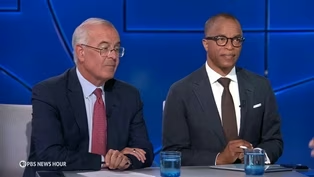
Brooks and Capehart on Blanche’s stalled AG confirmation
Video has Closed Captions
Brooks and Capehart on Blanche’s stalled nomination and Trump's 'anti-weaponization fund' (10m 42s)

Groups that shape community culture face financial pressure
Video has Closed Captions
Local arts groups that shape community culture face financial pressure (7m 15s)
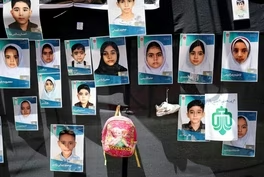
How people in Iran feel after living through months of war
Video has Closed Captions
How Iranians are living through months of war and government crackdowns (6m 10s)

Migrants enter Spanish territory, then return to Morocco
Video has Closed Captions
Tens of thousands of migrants enter Spanish territory, then return to Morocco (3m 7s)
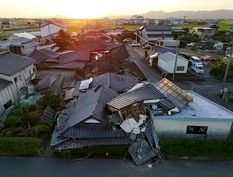
News Wrap: Death toll from Japan earthquake rises to 34
Video has Closed Captions
News Wrap: Death toll from Japan earthquake rises to 34 (5m 8s)
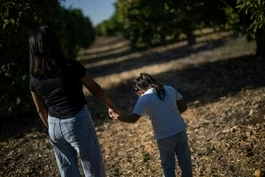
Unaccompanied migrant children could lose legal aid
Video has Closed Captions
Unaccompanied migrant children at risk of losing legal representation (5m 49s)
Western states face water cuts as Colorado River shrinks
Video has Closed Captions
Western states face more water cutbacks as Colorado River shrinks (4m 53s)
What's in the deal to disarm Hamas, withdraw IDF from Gaza
Video has Closed Captions
What's in the proposed deal to disarm Hamas and withdraw Israeli forces from Gaza (5m 46s)

Why states want to change 'Sell By' labels on food
Video has Closed Captions
Why states want to change 'Sell By' labels on food (3m 20s)
Providing Support for PBS.org
Learn Moreabout PBS online sponsorship New Episode
- News and Public Affairs

Today's top journalists discuss Washington's current political events and public affairs.

- News and Public Affairs

FRONTLINE is investigative journalism that questions, explains and changes our world.
 New Episode
 New Episode
 New Episode
 New Episode

 New Episode
 New Episode
 New Episode
 New Episode
Support for PBS provided by:
Major corporate funding for the PBS News Hour is provided by BDO, BNSF, Consumer Cellular, American Cruise Lines, and Raymond James. Funding for the PBS NewsHour Weekend is provided by...