
Oranges & Avocados: A Tale of Two Fruits
Season 9 Episode 2 | 27m 4sVideo has Closed Captions
Exploring two fruit trees that transformed Southern California.
Southern California was built on agriculture. Nathan visits the Parent Washington navel orange tree and traces the rise of the Hass avocado.
Problems playing video? | Closed Captioning Feedback
Problems playing video? | Closed Captioning Feedback
Lost LA is a local public television program presented by PBS SoCal
Oranges & Avocados: A Tale of Two Fruits
Season 9 Episode 2 | 27m 4sVideo has Closed Captions
Southern California was built on agriculture. Nathan visits the Parent Washington navel orange tree and traces the rise of the Hass avocado.
Problems playing video? | Closed Captioning Feedback
Where to Watch Lost LA
Lost LA is available to stream on pbs.org and the PBS app.
Providing Support for PBS.org
Learn Moreabout PBS online sponsorshipNathan: So, this is it, the most important tree in the history of avocadoes.
Rob: From this tree, a global industry developed.
Tracy: So this is an orange inside an orange.
Nathan: So, this right here is why we call it a navel orange?
Tracy: It is.
And in fact, this is the best example I've seen in a long time.
Georgios: Nobody touches the tree other than actually PhDs, people with doctorates that they know what they're doing.
Nathan: You need a PhD to touch this tree?
Georgios: Oh, absolutely.
Yes.
Nathan: Wow.
Rob: Uh, it's a thing of beauty.
Okay.
We're gonna put a little X on that one, and we'll send you a picture in three weeks.
Narrator: This program was made possible in part by a grant from Anne Ray Foundation, a Margaret A. Cargill Philanthropy, and the Roy + Patricia Disney Family Foundation.
Nathan: Just off one of the busiest intersections in Riverside stands a tree that changed Southern California forever.
Born more than a century and a half ago, this tree began as a chance mutation in the garden of a Brazilian monastery.
From Brazil, it traveled by ship to a USDA greenhouse in Washington, DC.
And from there, by train, stagecoach, and buckboard wagon to the farm of Luther and Eliza Tibbets.
As the story goes, Eliza nursed the young plant through Riverside's hot summers with leftover dishwater.
It survived, and this tree, along with its long-lost sibling, became the ancestor of nearly every navel orange grown in California.
Georgios: Welcome, Nathan.
Nathan: Thank you.
Thanks for meeting me here.
Georgios: Absolutely.
Nathan: Yeah.
Georgios: Come inside, but don't take too many steps.
Nathan: Yeah.
This is a maximum security fruit tree.
Georgios Vidalakis, a plant pathologist at UC Riverside, works with Sohrab Bodaghi and other members of his team to not only protect this historic tree from disease and pests, but the entire global citrus crop as well.
Georgios: So, you see, this is the trunk, the original trunk, the 1873 trunk.
Nathan: Wow.
Georgios: And you see how this looks a little bit better than this section?
Nathan: Yeah.
Georgios: This is what we call a Phytophthora lesion.
The fungus-- actually it's not a true fungi, it's an--what we call an oomyces.
Almost killed completely, did what we call girdling the tree.
And then the wood inside is dead that moves water up and down.
But when the bark dies, the tree dies.
Nathan: So, by girdling, you mean if it went all the way around that's the end of the tree.
Georgios: Exactly.
So, the tree did its best and stopped it right there.
This is what we call healing tissue.
But it needed help.
Nathan: Wow.
Georgios: So, in the 1920s, the University of California... Nathan: Yeah.
Georgios: came in and we did what we call inarching.
So, we planted young seedlings around the tree and the original tree start using the roots, uh, and the bark.
You see how this bark is not injured, uh, and feeding itself.
Nathan: There's so much more engineering behind this tree than you would ever realize.
Georgios: Right.
Nathan: And it does not just grow and survive on its own naturally?
Georgios: No, uh, unfortunately, it would have died if science hasn't intervened.
Nathan: So, this is a beloved tree.
I mean, you're actively taking care of this, helping it survive.
Georgios: Oh, yeah, absolutely.
So, the rule-- the general rule is that because this belongs to the City of Riverside and this is a tiny park, actually.
It's designated as a park.
They can come and clean and pick up the leaves.
But nobody touches the tree other than actually PhDs, people with doctorates that they know what they're doing.
Nathan: You need a PhD to touch this tree?
Georgios: Oh, absolutely, yes.
Nathan: Wow.
Georgios: We don't allow anybody else.
Nathan: So, science has spent half a billion dollars trying to find solutions to these problems.
And that's largely because it's a huge multi-billion dollar industry... Georgios: Absolutely.
Nathan: growing fruit.
But why save this tree?
Georgios: I believe it was 2020 that an economist did a study.
The California industry alone is estimated of a value of $3.6 billion.
Economic activity to-- close to $8 billion and essentially, all of it can be traced back to this tree.
So, this beautiful fruit from California was sold all the way to the East Coast of the United States.
Nathan: Yeah.
And they were wrapped in tissue, right?
Georgios: Oh, yeah, they were precious.
It was like a Christmas gift you will get at California.
Actually, they were called back then the Riverside navels.
Nathan: Riverside.
And these were-- these were delicacies.
These were luxuries, right?
I mean, today you can buy these like a few dollars a pound, but back then this was a holiday treat.
Georgios: Correct, absolutely.
Because the variety was introduced from Brazil to the United States through Washington, DC.
Nathan: Yeah.
Georgios: Sanders was the name of the gentleman that made the connections with missionaries down in Brazil.
Nathan: At the USDA.
Georgios: At the USDA.
Nathan: Yeah.
Georgios: They put-- if I remember well, they put 12 in a box.
Uh, a lot survived.
He propagated even more and he sent these trees.
He sent them all over the country, not only in Riverside.
Nathan: Oh.
Georgios: San Francisco, San Diego, Florida, but again, that very old report from USDA said the other trees didn't do well, but the Riverside ones flourished.
Like today, Southern California has always been a melting pot.
So, you can see actual pictures of people working with the tree or trees and they're immigrants from Asia, from Europe... Nathan: Right.
Georgios: where citrus existed for thousands of years.
So, I want to believe that a little bit, uh, diverse community of, uh, Riverside, plus I met a few years ago a senior of the Kumeyaay people, the local Native American people in, uh, in our region.
And he told me, "Georgios, yes, and it's been part of our tradition as well.
When the citrus industry took off, it was our people that knew where the water is, right, where the fertile ground is."
Nathan: Yeah.
Georgios: So, it's a community team effort for me.
That's why this tree was successful.
Nathan: That's really interesting.
And when we talk about the success of citriculture in Southern California, we talk about the physical landscape usually... Georgios: Uh-huh.
Nathan: but the cultural landscape, you're saying, was just as important?
Georgios: Absolutely.
This is the perfect place to grow citrus, no question about it.
There you are.
You are doing great.
Nathan: Oh, yeah.
Georgios: Ready?
Nathan: Yeah.
Georgios: Cheers.
Nathan: Cheers.
Mmm.
150-year-old tree.
The fruit is... Georgios: Is beautiful.
Nathan: Yeah.
Georgios: Shall I come close?
[Laughter] Nathan: The citrus boom that this tree launched needed science to sustain it.
In 1907, University of California researchers established an experiment station, first in Pomona, then here in Riverside, to study and develop the region's most important crop.
Three years later, they began assembling an unrivaled collection of citrus trees that's been growing ever since.
Today, the Givaudan Citrus Variety Collection at UC Riverside holds 4,500 trees representing nearly 1,100 cultivars.
I went to meet its curator, botanist Tracy Kahn.
So, this collection today, it's part of UC Riverside.
Tracy: Yes.
Nathan: But in some ways, this is the forerunner to UC Riverside.
It's the reason UC Riverside is here.
And that was more than 100 years ago.
And there's no collection in the world like this.
Tracy: There are collections associated with universities, but, um, most of them are nowhere near this first.
Nathan: Yeah.
And you couldn't build a collection like this from scratch today.
Tracy: No, I think it would be really difficult to breed a collection like this.
I think that's why it's so very important to make sure it gets preserved, not only for what we can use it for, but to have that history and to have that understanding of the diversity of citrus.
Nathan: Now, I see you have here the "Washington Navel Orange."
This particular variety does loom large in the lore of this place.
Tracy: It does.
This is a publication from 1933... Nathan: Yeah.
Tracy: a citrus publication.
But it's from the Riverside Chamber of Commerce, which connects it to this location as well.
Nathan: Sure.
Sure.
Tracy: And this is the one where they honor Mrs.
Eliza Tibbets for planting it in 1873.
Nathan: The origins of it are all shrouded in mystery.
And there's also--it's-- curiously, uh, Luther Tibbets is not represented here.
Tracy: No, he is not.
Nathan: He's, more or less, been written out of the story.
Tracy: Right.
I got to take this really cool class at UCR when I was a graduate student here, and it was taught by a guy named Bill Bitters, who was the curator before me from 1946 to 1982.
And he taught us in this class about the parent Washington navel.
Its connection to Riverside.
Nathan: Yeah.
Tracy: So, this is one of the things that he kept, and this is actually his handwriting, which is one reason I kept it.
Nathan: Oh, yeah, you gotta keep that.
Tracy: People used to argue about which year it came.
[Nathan laughs] Tracy: So, this one confirms that it was December 1873.
Nathan: Uh-huh.
Tracy: It said that there were two trees, but apparently, there--that was wrong.
There were actually three trees.
Nathan: I've heard that, yes.
Tracy: So--and so on page 138, it talks about the three trees, um, that were planted in 1874.
One of those trees, and it's talked about on page 139, was actually trampled by a cow, as how I learned it, but by cattle, and it died.
So, what we usually think about is two trees in some places, right?
Just about those two trees.
Nathan: Yeah.
We don't--we don't talk about the third tree.
Tracy: And this one, uh, I guess from page 127 to 161, it talks about Luther's role in the whole thing, as the founder of the navel orange.
Eliza's family actually pushed her as being the founder, but this article shows that, on page 145, that she didn't arrive till two years after the trees did.
Nathan: So, whatever the truth of this--of the matter, there was this generally-accepted mythology around the origin.
And I can imagine that had a lot more importance, say, in 1920, when Riverside was still this huge citrus-producing community.
And not only Riverside, but Redlands and Pomona.
And it was part of the region's identity.
Tracy: Definitely.
I mean, it was the first one that was brightly-colored, sweet, "fairly easy to peel..." Nathan: Uh-hmm.
Tracy: and had no seeds.
It was, you know, something people were really excited about, you know.
Nathan: So, you have two of this parent Washington navel trees right over here, right?
Tracy: I have four.
Two trees, uh, from--one from each of the two original trees.
Nathan: Wow.
Okay.
Well, let's go take a look.
Tracy: Okay.
Nathan: Okay.
So, these are navel oranges then?
Tracy: These are navel oranges.
Nathan: Yeah.
Tracy: And in fact, at the time these were originally propagated, we still had two trees in Riverside.
Now we only have one of the original trees.
Nathan: The other original tree was transplanted to the grounds of Riverside's Mission Inn by President Theodore Roosevelt himself, a fitting honor for the most economically-significant tree in California history.
It survived there for nearly two decades before disease claimed it in 1922.
Tracy: We've got fruit here.
We've some really big fruit.
Nathan: Those are big fruits.
Wow!
Tracy: These are big fruits.
Nathan: That's a big orange.
Tracy: That's a big orange.
Nathan: I mean, this is almost the size of a grapefruit.
Tracy: Yeah.
There-- Nathan: There we go.
Oh, yeah.
Tracy: So, you can really see, and this one is great.
So, this is an orange inside an orange.
Nathan: So, this right here is why we call it a navel orange?
Tracy: It is.
And in fact, this is the best example I've seen in a long time, 'cause you can actually see the rind of the smaller orange inside the larger orange.
Nathan: We just got lucky by pulling that off the tree.
Tracy: Yeah, we did.
You wanna taste it and see?
Nathan: Yeah.
Let's do it.
Tracy: I mean, you can smell it, but it's-- Nathan: Yeah.
I mean, quite fragrant.
Tracy: There you go.
Nathan: Oh, thank you.
I mean, it tastes just like the orange, like the Tibbets orange... Tracy: Okay, good.
Nathan: which makes a lot of sense because it's essentially the same tree.
Tracy: Right.
That's good.
Well, I'm glad you've tasted both in the same day.
Nathan: That's delicious.
Wow.
Tracy: Not many people can say that.
Nathan: No.
This orchard doesn't just preserve the past.
It's the Silicon Valley of citrus, a hub of innovation where new varieties are born.
The Tango mandarin, which you may know from the supermarket as a Cutie, was developed right here.
Of course, not every discovery happens in a lab or a research orchard.
The Cara Cara was a natural mutation first spotted on a farm in Venezuela.
This right here looks like a navel orange tree.
Tracy: It is.
It's a navel orange tree, but it happens to be a cultivar that we call Cara Cara.
Nathan: Okay.
Oh, wow, I can already see.
It--it's pink, it's like a grapefruit almost.
Tracy: Yeah.
Nathan: Wow.
Tracy: It's the same pigments in pink grapefruits.
It's called lycopene.
Nathan: Uh-huh.
Tracy: And it's the same pigment in tomatoes, too.
Lycopene.
Nathan: Really?
Wow.
Yeah.
I mean, the pink adds a little visual interest.
And does it taste roughly the same?
Tracy: It does.
You wanna taste it?
Nathan: Yeah, please.
Tracy: Okay.
There you go.
Nathan: Oh, thank you.
Okay.
Mmm.
Yeah.
I mean, it tastes--it's good.
It tastes the same.
Tracy: But it's pink.
Nathan: So, I think on the way over here, we passed what looked like a mandarin tree?
Tracy: Yes.
This is a mandarin tree.
Nathan: And this is-- if I'm not mistaken, it's essentially one of the ancestors of what we know as the orange?
Tracy: We don't know if this particular tree or cultivar is an ancestor, but we know that, based on its genetics, that, yes, this type is in the ancestor group of mandarins, which are not most of the mandarins you're eating from the store.
Nathan: Yeah.
Tracy: Most of the mandarins you're eating from the store, like Clementines or Tango... Nathan: Right.
Tracy: they have a little bit of pomelo genes in it.
Nathan: Oh, they do?
But this is a pure mandarin?
Tracy: This is a pure mandarin.
Nathan: And the orange, is that a--it's a hybrid of the mandarin and the pomelo?
Tracy: Happened way before humans were around, but yes.
Nathan: Do you think we could pick one of these and pick one of the pomelos and taste them together?
Tracy: Uh, we could.
We could do that.
Let's take a couple... Nathan: Okay.
Yeah.
These are small.
Yeah.
So, we're going from a tree with really small fruits to a tree with some pretty big ones.
Tracy: Right this is a-- called Moanalua pomelo.
Nathan: Oh, my goodness.
Tracy: There we go.
Nathan: [Laughs] So, essentially, the orange is a cross between the pomelo and a mandarin?
Tracy: But it wasn't just one cross.
Uh, we're talking about huge amounts of time.
Nathan: Yeah.
Tracy: Since citrus probably originated about 8 million years ago, there were crosses back and forth, back and forth... Nathan: Right.
Tracy: through lots and lots of time, that generated what we think of as sweet oranges.
And then sweet oranges are all genetically very similar.
They're, like, 99% genetically identical.
Nathan: Uh-hmm.
Tracy: But that includes things like the navels, but also blood oranges.
Nathan: Uh-hmm.
Tracy: So, that 1% can make quite a bit of difference.
Nathan: Right.
Are you gonna-- you're gonna have it with me?
Tracy: Okay.
Let's go.
Nathan: Oh.
Actually, that's pretty tasty.
It's not... Tracy: Yeah.
Nathan: too bitter.
Tracy: Okay.
Mandarins have that characteristic where they just fall out of their peel.
Nathan: Oh, yeah.
Oh, these are some little guys here.
Wow.
I'm gonna have one little--uh, mmm.
You can see how a cross between this fruit here and this fruit here could produce an orange, you know.
[Laughter] Tracy: Oh, I think I've never done that together.
Nathan: Well, there you go.
I'm glad--and you've probably done all things citrus under the sun.
Tracy: [Laughs] Yeah.
Nathan: The navel orange wasn't the only Southern California crop whose entire history traces back to a single, improbable tree.
The avocado has a similar story and an equally unlikely hero.
DJ: The strangest thing, the avocado, but it has a complicated and fascinating story.
And we're gonna have some fun telling it.
Nathan: That story begins long ago, when avocados co-evolved with the giant ground sloths and mastodons that once roamed the Americas.
When those creatures vanished, the avocado persisted and became an evolutionary ghost.
It survived because humans intervened, cultivating it across Mesoamerica for thousands of years before it made its way up north.
Today, I'm driving with DJ Waldie, one of Southern California's most perceptive chroniclers, who wrote about the history of the avocado in his latest book.
His essay traced how this ancient fruit, once dismissed as the ungainly "Alligator Pear" was transformed by California growers into something you spread on your morning toast.
There is one we need to talk about, who created the avocado that we really know today and put it on our plates, and in--on our--uh, your produce stands.
DJ: Exactly.
An unassuming mailman... Nathan: Yeah.
DJ: Rudolph Hass.
Nathan: Rudolph Hass.
In 1926, a postal worker named Rudolph Hass pulled his savings and borrowed money from his sister to buy a one and a half acre avocado grove in La Habra Heights.
And one tree on that property would go on to change everything.
Rob: Hello.
Rob Brokaw.
Nathan: Thanks for having us.
Nice to meet you.
Rob: Good to meet you.
Nathan: So, is the tree in here?
Rob: The tree's inside there, yeah.
Nathan: Let's take a look?
Rob: Wanna take a look?
Here we go.
Nathan: Wow.
So, this is it, the most important tree in the history of avocados.
Rob: From this tree, a global industry developed.
Yes.
Nathan: So, anybody who's had a bowl of guacamole or, uh, avocado toast, those avocados probably descended from this tree?
Rob: Most likely, yes.
And it almost didn't happen.
There are a couple of different versions of the story that vary in different details.
Nathan: History often is that way, yeah.
Rob: I don't quite remember it.
Nathan: Okay.
Rob: But the genesis of it all is a guy named Albert Rideout, who was my great-uncle's brother-in-law.
And he was also a nursery man and a breeder, and an avocado enthusiast.
And what he would do would be to sprout avocado seeds that he got almost anywhere, any seed, and sell those seeds to people who were planting orchards.
And those seeds would be planted in the orchard, as was the case with Mr.
Hass's orchard.
They went ahead and performed that grafting on the trees and one of 'em failed.
The tree actually produced some very strange fruit and Mr.
Hass's kids loved the fruit, so they asked him not to graft it.
Rob: And he eventually decided to patent the variety and commercialize it.
DJ: And the issue there, of course, was that the fruit, as it ripened, turned black.
Rob: That's right.
All of the avocados in the markets in those days were green colored, and they were, uh, differently-shaped than the Hass.
And so this was a new wrinkle in the industry, and change isn't always the thing that markets really look for.
Nathan: So, to the untrained eye, it might've appeared like a dud.
Rob: Yes.
Well, the black fruit was associated with rot.
DJ: Yeah.
But the question is, why are we looking at this pile of what looks like firewood?
Rob: Well, Mr.
Hass's original tree lived for many, many years, uh, but it eventually was infected with a fungus that attacked its roots and started to die.
And my father, who had his own nursery at that time, kind of took it on himself to try to nurture that tree and help it out.
But finally, in, I believe 2002, he lost that battle.
DJ: So, Nathan, this is... Nathan: Yeah.
DJ: kind of like a shrine.
Nathan: It really is like a shrine, right?
I mean, this is clearly a well-loved tree, basically has an entire barn to itself, right?
Rob: Well, yes.
Rob: That's--it is the, yes, the barn's purpose.
Nathan: Yeah.
A short drive down Highway 126 took us to the Brokaw Nursery, which produces hundreds of thousands of avocado trees a year, many of them a direct genetic descendant of Mother Hass.
Our shoes are gonna take a, uh, decontamination bath.
DJ: All right.
Show me the drill.
Nathan: Okay.
DJ: You're now decontaminated.
Nathan: And now, it's the Jeep's turn.
DJ: Okay.
Nathan: Okay.
Wow.
Just love the lighting in a greenhouse.
Rob: Yeah.
It's always nice.
So, here we are at the nursery and, uh, this is where we reproduce the trees, and we make about 300,000, 400,000 avocado trees a year.
DJ: Wow.
Nathan: Wow.
Rob: So, the central operation here is grafting.
So, what we do is we get seeds and we grow up those stems, and we graft, we take a little twig from a Hass tree and we splice it into the stem of a seedling.
And then everything that grows out of that bud on that little twig produces fruit that's exactly the same as the tree that we took the twig from.
Nathan: Yeah.
Rob: We have one really special grafter that we want you to meet, and that's Consuelo over here.
Consuelo has been working with us for, we figured out just now, 56 years.
Nathan: Wow, more than half a century.
Rob: More than a half a century.
Nathan: Wow.
That's a lot of avocado grafting.
Rob: Yes.
She worked alongside my father back in the day, and we just did the numbers, and we tried to figure out how many trees she has grafted in that time, and it came up to 9.1 million.
DJ: Heavens above.
Nathan: I'm afraid to say this, but it actually looks simpler than it sounds, but I'm sure it's not a simple task to perform.
Rob: Well, you're about to find out.
Nathan: [Laughs] Okay.
DJ: Okay.
Nathan: You'll, uh, provide some encouragement?
DJ: Uh, well... Nathan: Okay.
DJ: Or first aid, depending about what happens.
Nathan: That's right.
Consuelo: [Speaking Spanish] Nathan: Okay.
Four of these.
Consuelo: Yeah.
Nathan: Oh, these are really baby avocado trees.
Rob: Yeah.
[Nathan laughs] Rob: So, these are the little grafts that we harvested this morning or yesterday from the Hass trees in our orchard.
Nathan: Okay.
Consuelo: And this.
Nathan: Sorry.
Oh.
Consuelo: Just a little more.
Rob: There.
Consuelo: Yeah.
Nathan: Okay.
Okay.
Now this is the part that I'm not gonna be able to do.
I-- Rob: Pull hard enough to get at this... Nathan: Right, right, right.
Rob: Hold just right.
Nathan: [Laughs] Yeah.
DJ: I'm not really helping much here, am I?
[Laughs] Rob: See, the problem is, it's really easy when she does it.
Nathan: You make-- you make it look easy.
Consuelo: [Speaking Spanish] Nathan: Okay.
Yeah.
Well, there we go.
[Laughs] Rob: It's a--it's a thing of beauty.
Okay.
We're gonna put a little X on that one, and we'll send you a picture in three weeks.
[Laughter] Rob: So, this is about five weeks later.
Nathan: Oh, five weeks?
Okay.
Rob: It takes about three weeks for that--for those cut surfaces to come together and heal.
Nathan: Yeah.
Rob: And the sap starts flowing across there, it fuels the development of those buds, and you see that nice growth coming out.
Nathan: Look at those beautiful leaves.
Rob: Yeah.
Nathan: Yeah.
Rob: Let's unravel this thing and see if we can see what the bud union looks like.
Nathan: Bandages come off.
DJ: Yeah.
Rob: Yeah.
We're showing the scars.
Very little trauma, a little bit of scar tissue down here at the bottom.
Nathan: Yeah.
Rob: But that's fine, it'll grow right over it.
And that tree is on its way.
Nathan: I don't know how many places you can see this many varieties of avocado.
DJ: It's astonishing, really.
Consuelo F: Yeah.
So, we have about 200 different cultivars planted up in our orchard, so that way, we have a bunch of different genes over here.
DJ: Maybe you could explain what a cultivar is.
Consuelo F: Cultivar, it's a genetically-different avocado, like one from another.
So, for example, one of the avocado cultivars, the Hass, it's the most common, that's what's being sold nowadays, but we've also gone through a lot of different cultivars or selections in the past, like the Fuerte here, it was one of the initial ones in the California industry.
And then we have Bacon that's a pollinizer cultivar.
So, they all have different characteristics and different flavors.
DJ: Ah.
Nathan: This doesn't taste like bacon though, does it?
Consuelo F: No, unfortunately, it doesn't.
Nathan: Okay.
Now, Prop.
2, I don't remember voting on that one.
[Laughter] Consuelo F: That's still a secret.
It's a new one that--you might be seeing in the industry in the future.
Nathan: Okay.
Just don't show anybody on TV.
Rob: Right.
Consuelo F: So, I'll cut one of the Fuertes.
Oh.
Nathan: And if you were eating an avocado in 1920, it would've been this?
DJ: That would've been the avocado.
Nathan: In California.
DJ: Yeah.
Ooh.
Nathan: Ah.
Nathan: That looks like a beaut.
DJ: Beautiful.
Consuelo F: Do you want to try some?
Nathan: Why not?
Yes, of course.
[Laughter] DJ: I've never had a Fuerte, uh, avocado.
Nathan: I don't believe I have either.
Rob: Big occasion.
Nathan: A sliver of that.
Mmm.
DJ: It's very good, but different from the Hass.
Nathan: It is different, yeah.
DJ: Mr.
Brokaw, you're following in the line of cultivators of avocados going back 12,000 years.
Uh, indigenous people in Central Mexico and Central America and Guatemala, they brought together some of these cultivars and made some of these avocados possible.
Nathan: Your family's been innovating for a long time, and there's evidence of that right here.
The innovation goes on, though.
Rob: Yes.
The Hass has been around for a century now.
We know that we need new varieties, and so we're trying to identify some new varieties that might be acceptable for entry into the commercial realm.
Nathan: Up the hill from the nursery, Rob and Consuelo maintain an orchard of some 200 cultivars, a living laboratory that just might produce the next Mother Hass.
Got it.
Okay.
DJ: That might be the avocado of the future.
Rob: You never know.
Nathan: You never know.
So, if in the greenhouse you were coddling the avocado trees, out here you're exposing them to the elements.
Rob: Yeah.
Now they're at war.
Yes, yes.
So, they're challenged, we do what we can for them out here, and we can give them very precise doses of water and fertilizer.
We can prune them, but we can't fully protect them, so... Nathan: Uh-hmm.
Rob: they have to do their part.
DJ: It is quite spectacular to see all of this work done on this land, the work that you and your family have done over many, many years, Consuelo has done.
To be on this, uh, hillside, overlooking, uh, the long valley is, uh, just an amazing experience.
Rob: You know, it all ties back to Mr.
Hass and his leaving the graft off of that tree and enabling everything that we've been able to do since.
DJ: Yeah.
An amazing, unexpected chance discovery.
[Upbeat music playing]
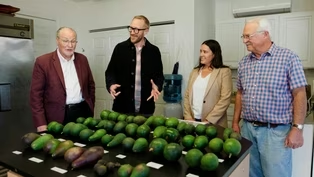
Oranges & Avocados: A Tale of Two Fruits (Preview)
Video has Closed Captions
Preview: S9 Ep2 | 30s | Exploring two fruit trees that transformed Southern California. (30s)
Providing Support for PBS.org
Learn Moreabout PBS online sponsorship














Support for PBS provided by:
Lost LA is a local public television program presented by PBS SoCal