
Prairie Yard & Garden
What is an Arborist
Season 39 Episode 13 | 28m 45sVideo has Closed Captions
Insects, diseases, drought, and flooding are putting intense stress on our trees. Who do you call?
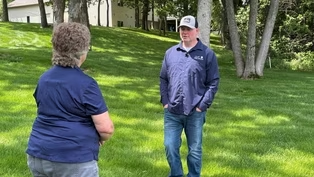
With insects, diseases, and weather stressing our trees, host Mary Holm visits Evan Amundson, Arborist and COO of Carr's Tree Service, to learn who to call for expert help. Amundson sheds light on the work of an arborist, demonstrating how they diagnose problems and provide practical solutions for complex tree issues.
Problems playing video? | Closed Captioning Feedback
Problems playing video? | Closed Captioning Feedback
Prairie Yard & Garden is a local public television program presented by Pioneer PBS
Production sponsorship is provided by Shalom Hill Farm, Heartland Motor Company, North Dakota State University, Friends of Prairie Yard & Garden, and viewers like you.
Support provided by:


Prairie Yard & Garden
What is an Arborist
Season 39 Episode 13 | 28m 45sVideo has Closed Captions
With insects, diseases, and weather stressing our trees, host Mary Holm visits Evan Amundson, Arborist and COO of Carr's Tree Service, to learn who to call for expert help. Amundson sheds light on the work of an arborist, demonstrating how they diagnose problems and provide practical solutions for complex tree issues.
Problems playing video? | Closed Captioning Feedback
Where to Watch Prairie Yard & Garden
Prairie Yard & Garden is available to stream on pbs.org and the PBS app.
Visit the Prairie Yard & Garden Website
Do you love gardening? Consider becoming a friend of Prairie Yard & Garden to support this show and receive gifts with your contribution. Visit the link below to do so or visit pioneer.org/donate.Providing Support for PBS.org
Learn Moreabout PBS online sponsorship(gentle music) - Tom often tells people that when we bought our home, I bought it for the house and he bought it for the yard.
He loves trees and this yard has lots of beautiful trees.
However, some of the trees had a shorter lifespan, so they had to go.
Last year, we had two more that were really in tough shape and needed to be removed.
We asked our neighbor who does landscaping, if he would take them down.
He said he didn't have the right equipment, and we should contact an arborist.
Well join me as we find out why that is so important.
- [Narrator] Funding for Prairie Yard and Garden is provided by Heartland Motor Company, providing service to Minnesota and the Dakotas for over 30 years in the heart of Truck Country.
Heartland Motor Company, we have your best interest at heart, (bright music) North Dakota State University, through its Field to Fork educational program, providing research-based information on growing, preparing, and preserving fruits and vegetables, Mark and Margaret Yackel-Juleen, in honor of Shalom Hill Farm, a nonprofit, rural education retreat center in a beautiful prairie setting near Wyndham, Minnesota, and by friends of Prairie Yard and Garden, a community of supporters like you who engage in the long-term growth of the series.
To become a friend of Prairie Yard and Garden, visit pioneer.org/pyg.
(bright music continues) (bright music continues) - We needed two trees removed from our yard, so we contacted our local arborist and a few short hours later, the trees were removed safely and the cleanup was all taken care of.
Well, that got me to wondering, what do arborists do in addition to tree removal?
So I called Carr's Tree Service, and Evan Amundson said, "We could come to find out."
Thanks, Evan, for letting us come out and find out what you and your company do.
- Yeah, thanks for the opportunity for letting us share our years of experience and how to help people with their trees.
- What is an arborist?
- An arborist is someone who has done more than just knows something about trees.
They've done studying and taken tests and done continuing education to know what's new and upcoming with tree diseases, insect problems, soil issues, and then how to help people solve those issues that they have with their trees.
- How do you become an arborist?
- So to become an arborist, you have to have had at least three years of experience in the field or have a horticulture or a forestry degree.
Additionally, there's an entity called International Society of Arboriculture, and that is really who does the credentialing for becoming an ISA-certified arborist.
So the certified arborist piece really sets you apart because we're following a standardized set of testing that anybody in the world can say, "I am a certified arborist through the ISA and it's gonna be consistent."
- What do arborists do?
- So there's many different types of arborists and I think that as a general rule of thumb, if you consider what an arborist does is, they try to help people take care of trees.
The arborist can do that in many different ways.
Some are consulting arborists that maybe would go out and be like a doctor and say, "Is there something wrong with my tree?"
So if somebody's calls us and says, "There's something that just doesn't seem right on my tree, there's a portion of it that's dying.
What is going on?"
Well, that would be a call that our consulting arborists would go out and address and try to identify different diseases or insects or cultural issues that were going on that maybe were causing the tree to go into decline.
Additionally, you can also have climbing arborists.
If there's a tree that we can't get certain types of equipment to, there's actually a specialist that's called a specialist certified climbing arborist.
There's a certification just for that.
- So what is your background?
- My background really starts when I was a young boy, growing up, my father and mom and our whole family, we would go down the woods and cut trees for firewood and it was actually how we heated our house.
And I was always intrigued with my dad knowing all the different species of trees that there were out there, and it was something that I thought was pretty cool.
I didn't intend on this being a career path for me, but when I was attending college at Bethel College for kinesiology, it was a summer job and I just found that it was something that I was passionate about and life always brought me back to helping people take care of their trees.
I have been an arborist for 22 years now, so started out working in the ground and helping the folks that were doing the tree removals and tree pruning into learning to be the climbing arborist and then to managing people and then to diagnosing different disease and insects like the trees that we've got around here into obviously, the role that I'm currently in, which is more so managing a lot of people and trying to build a culture of Carr's Tree Service to be more than just cutting trees down, but that we're actually here, that we care, we care about the trees and we care about the clients and we want to provide people with as much education as we can so they can make really sound decisions on what to do with their trees because it's their trees.
They know the history better than I do.
I can just help give them guidance and best practices to follow.
- Do you and your staff have to keep going to school or take classes?
- Yes, so continuing education does have to happen to maintain those accreditations and certifications.
And then additionally, we do internal trainings as well with tailgate safety sessions and sessions that start our day out with getting better each day.
- Why is it important for people to get a certified arborist to do their work?
- I attribute it similar to would you go to a doctor that's not an accredited doctor?
Probably not.
You know, you're gonna want to go to a doctor that's been vetted out that you know is accredited by an outside source that's gonna take care of your ailments, and you can trust that because they have been vetted out.
So a certified arborist simply is saying that there's an outside entity, in this case, the International Society of Arboriculture, that has vetted this individual out, that they've passed the test to prove that they know about soil composition, they know about tree biology, they know about the way that trees function and the environments around them.
- Tell me about Carr's Tree Service.
- Carr's Tree Service is over 50 years old.
We're owned by 10 power line cooperatives and with that gives us some nice flexibility of resources and we actually service Minnesota, Wisconsin, Iowa, South Dakota, North Dakota.
That geographic reach for us has been really nice because our guys work where they live.
We don't ship people in and out.
We're local companies.
We train our staff to have all of the knowledge that they need to be successful in the jobs that they do for our clients.
Our main clients are private, utility, and government.
And in that, we work for the Department of Natural Resources, US Fish and Wildlife, Pheasants Forever and Ducks Unlimited.
On the government side of things, we do a lot of work with different cities to prevent emerald ash borer and then also with the destruction of emerald as borer to remove trees.
We work with a lot of cities for Dutch elm disease removal and treatments as well to protect their trees that they have in an urban setting.
So utility side of things, we're working clearing for pipelines.
Utility is also is our power, overhead power that we have coming and feeding the homes that we have that we rely on, day in and day out.
And then private, of course, is what we call residential and commercial.
So we've got residential folks, but we also have commercial properties that need their trees taken care of too.
A lot of trees don't really like being in the middle of parking lots with asphalt all around them.
And so many times those trees will need maintenance as well from a commercial setting.
- There's a lot going on to being an arborist.
You must have a lot of tools and equipment.
- We do.
- Can we see what that looks like?
- Let's go!
(bright music) - What did you know about hummus about 10 years ago?
Hummus is a staple in Mediterranean-style cuisine and it's become very popular among US consumers.
It's versatile, it's high-end fiber and it's also nutritious.
Hummus is made from chickpeas, which are also called garbanzo beans.
Technically, you can substitute any white bean and remember that all beans are part of the pulse family.
Pulses in general are notably nutritious.
They're high in folate, they're high in fiber, they're high in protein.
And even better, they count either toward the vegetable group or the protein foods group.
So let's make hummus with about five ingredients, and you can add some extra ones if you'd like.
To make hummus, we start with a 15-ounce can of drained, rinsed chickpeas.
So let's start by pureing our chickpeas.
You can use a food processor or a blender.
(blender whirs) Next, I'm adding tahini.
You may not be familiar with this.
This is sesame seed paste and it adds our characteristic flavor to hummus.
Next, we add 1/4 cup lemon juice.
Fresh lemon juice would be preferable, but you can use bottled.
Next, we're adding three minced cloves of garlic.
Next, I'm adding a teaspoon of salt.
You can add less if you prefer.
Finally, we're adding a little bit of cumin to taste.
This adds an exotic flavor and we puree until smooth.
(blender whirs) This easy and delicious recipe for hummus makes 12 servings.
Each serving has 70 calories, three grams of protein, and two grams of fiber.
This is Dr.
Julie, bringing you from field to fork.
Until next time.
(bright music continues) - And Evan, about how many locations does your company have?
- We have about 15 locations from Fargo, North Dakota, kind of all the way down to Rochester, Owatonna, New Ulm and Mankato area.
So we cover all of Minnesota, like I said, and good portion of the surrounding states.
- Do you have all of this equipment at each location?
- We do, yes.
We have this and much more.
So each of our locations has specified equipment that is needed.
Southern Minnesota's got some terrain that's a little bit different than some of the Northern Minnesota does.
So we utilize specialized equipment throughout the state.
Generally speaking, when we go out and look at a project, we identify how much time we think it's going to take and the right equipment that we need out there.
And many times, that means we need a way to get material or tree debris from a backyard to a front yard.
And so that's where our forwarding machines come in, ranging in size from our bigger machine, which is a payloader which we use to move the bigger debris piles around.
We've got skid loaders from there to toolcats.
They're a smaller machine that that helps us take some of the smaller debris out, down into a mini skid, which is a stand on machine that, you know, rather than having to put it all on a cart in a wheelbarrow like we used to, we've got an array of tools that are specific to each job that we go out to in each site that we go out to.
And so it's our consulting arborist job to identify those types of pieces of equipment and then inspect them accordingly.
Additionally, we've got bucket trucks for flying around our guys up in the trees whenever we can because it's a lot safer to use a bucket truck than it is to try to climb every single tree.
So there's different types of buckets though.
We've got some of our bucket trucks that have combination boxes on them that we can put wood chips into as well.
And so they work really good for our utility contracts where we have those bucket trucks with the dump box in them.
Whereas, many times in a residential setting, we've got really tight spots we need to get into where a flatbed, rear mount flatbed where the bucket's mounted on the back of the truck is better because we can get right up next to the tree that we're trying to get to.
Many times, we can't get any of our bucket trucks to it as well.
And we've got backyard buckets that are on tracks that we can actually get through a 36-inch gate that'll reach 72 feet high.
Because we have so many options, we can really make sure that we're the safest company out there, the most efficient company, and that when we're done, the job is gonna be cleaned up better than anybody else.
Technology has come a long ways.
We now utilize technology to track all of our equipment.
We have GPSs and many of our pieces of equipment with telematics that will tell us when we need an oil change, when there's a service that's due, if the tires are low.
Technology's allowed us to utilize the equipment as efficiently as and effectively as possible for scheduling.
It doesn't do us a whole lot of good to have equipment if we're not scheduling it accordingly.
Our resources are shared between all locations and that's one of the biggest challenges that we have being so spread out, is ensuring that everybody knows where those pieces of equipment are at any point in time.
Because if our bucket truck's not getting used here, but it's not needed here, but somebody down in southern Minnesota needs it, they also need to know that it's just sitting here.
So that's where that technology platform has really come in.
And then all of our staff has access to go into that format and say, "Oh, it looks like our bucket truck number 193 is down in the southwestern portion of our state," and make sure our equipment is maintained and on a rotation for replacement as well.
Because although, we're a tree service company, we also have 18 full-time mechanics on staff to maintain all of the equipment that we have.
- If a big storm comes through in an area, do you shuffle crews to that area to help take care of it?
- Yes, our teams are very willing to be flexible when there's storm settings coming in.
It looks like there's some, maybe clouds rolling this way right now.
In the past five years, there's been a storm in Minnesota every single year.
As you look at Minnesota and say, "Well, are there storms and what are we going to do?"
That's the nice thing about having 300 plus employees is, if there is an issue down in Rochester and we've got crews up in Ottertail, we will definitely shift our resources from Ottertail down into Rochester to try to help those folks get those trees off of their houses as as quickly as possible.
- What do you do to make sure your crew members stay safe?
- We do a lot and lot of training and we partner with the Tree Care Industry Association and we do much of our training through the TCIA.
We're one of three companies in the state of Minnesota that's accredited by the Tree Care Industry Association.
And so that's where we start is with our training.
Beyond that, we follow all ANSI and OSHA standards, which means we have to wear hard hats, safety glasses, gloves, toe protection, chaps when we're cutting, that PPE, that personal protective equipment that we have reduces or minimizes the consequence of something like that happening.
- And then what kinda smaller equipment do you use for the jobs?
- There's a lot of different techniques that we use.
Many times we can't get bucket trucks in there and so we have to climb trees.
And when we climb trees, there's different techniques that we have to utilize for getting, said hundred pounds pieces of weight down to the ground without creating huge craters or dropping them in people's houses.
So we use a lot of ropes and we coach our team a lot on how to use ropes properly, proper knot tying to go along with those ropes, physics.
And what does that have to do with with the tree service?
Well, we need to know how much our ropes can hold because if we tie on too big of a piece that's over a million dollar house and then make a cut, it doesn't really do us a whole lot of good when that rope snaps and that piece of wood is now in somebody's living room.
So knowing about physics, knowing about forces like vectors, knowing about how pieces are going to react, manipulate the pieces to get them to go where we want them to go when they don't necessarily want to go there.
- There is a lot to know about the safety!
- There is a lot to know and it really takes the team effort.
One of our sayings is "See something, say something" just because many times when you're in the heat of the battle, you don't even recognize that maybe something is unsafe.
So our team really, we coach them up on see something, say something because it takes everybody on that crew to make sure that you get home safely at the end of the day.
(bright music) - I have a question.
I have several shady areas in my yard and I don't wanna grow more hostas.
What do you recommend?
- Well, there's quite a few things that grow well in shade here besides hostas and coral bells, which are very commonly grown.
So a couple of things.
This right here is the Japanese Spikenard, Aralia cordata of cultivar called Sun King, which loves to grow in the shade and has beautiful light, yellow-green color.
So it that helps to brighten up a cool, dark spot.
Also, Astilbes which come in a variety of sizes from quite short to a few feet tall.
And they have these feathery plumes and shades of pink and white and red.
So that'll also help brighten up a shady spot with some very nice flowers.
These are past peak, but even the old flower heads look pretty cool.
Another thing is, over here we have a Siberian bugloss, the Brunnera macrophylla, this is a white-modeled leaf variety and they have beautiful little sky blue flowers in the springtime, much like a forget-me-not to which they're related, and they'll re-seed a little bit in the garden, but they make a nice, a little, a bright spot in a shady garden.
And another good group of plants for the shade are the Rodgersias.
And there's a number of different species, but they're all fairly similar.
They have big palmately divided leaves and they love the shade and they send up flower spikes, a couple of feet tall, sort of like an Astilbe, fluffy, sort of feathery flowers.
So that's a great one for the shade.
And also, many different kinds of ferns.
So remember the ferns, they're great in shady gardens.
(bright music) - Evan, what do you see as the major health issues for our trees and shrubs in our area at this time?
- Trees and shrubs have a lot of different issues dependent on the specific year.
So this year, what I'm seeing is, we had 90 degree temperatures early on in the spring and mother nature got a little bit confused.
After that, we had a cold snap and I don't know about you, but I put my garden in a little bit too soon and some of the plants that I have got frostbite from that.
And so, no different than that, many times trees will have issues in the spring if we have an environment that has an excess amounts of water and a cool environment.
And there's also times that in the spring, we have droughty issues or heat that comes on and then a cold snap that happens afterwards.
So this year, there's nothing specific that really jumps out to me with our environmental issues that we've had.
But emerald ash bore is still on the move.
It's a pesky little insect that's a flatheaded borer that continuing to be a problem for the trees in Minnesota.
We've got three main flathead borers that tend to be an issue: bronze birch borer, which affects the white birch trees, paper birch trees, typically, two-lined chestnut borer, which generally is going to attack our oak trees, which we have around us here.
And then, emerald ash borer, which of course, is killing all of our ash trees.
So many different types of insects and diseases affect our trees at all points in time.
This is where I like to refer my clients back to the disease triangle.
The disease triangle is really the pathogen, the host, and the environment, meaning you've got your disease or insect, that's a problem.
You have the host, which is going to be the tree, and then you have your environment.
So as we talk about foliar fungal diseases, you need moisture for that.
Cool, moist areas is where foliar fungal diseases generally thrive.
And so knowing that, if there's a spring where we were very dry in the spring, we likely won't have as many foliar fungal problems later on into the season.
It's really best to get with a certified arborist, have them identify what exact problems you're having with your specific species of trees and then be able to get a diagnosis and a prescription based off of those specific instances and problems that are happening in your area.
- What does your company do for disease and insect prevention?
- Well, it depends on the tree because there's many different types of insects and so, many times we have to first identify the type of insect that we want to treat.
We don't like to just put chemicals into trees or into the ground if we don't have to.
So first of all, it's really identifying and finding the correct solution or prescription to go with whatever that said problem is, because one of the forms of treatment that we do is called a macro injection.
It's where we have 50 some odd gallons of water based off the size of the tree that gets pressurized and pumped into the tree.
And that's through the vascular system of the tree.
So think about like an IV, right?
You're not just getting a shot in the leg, you're getting an IV that's pumping the medicine into you.
So that's just one form of treatment that we do.
There's also micro injections.
Micro is small, so small amounts of liquid, small amounts of the product that we need to send up into the tree.
We typically use that for our insecticides.
So for treating for emerald ash borer, bronze birch borer, two-lined chestnut borer, many of those types of insects will use this micro injection.
Furthermore, many times it's maybe a drought issue or something else.
And in that case, we'll do what's called the soil drench with a specific type of product where we'll actually dump it into the ground and it'll be the tree that does most of the work to bring that product up into the tree.
So depending on the severity of the disease or insect, depending on what the disease or insect is, is going to change what our prescription is and the timing of when we need to do it to be able to best manage said disease or insect.
- How long do these treatments last?
Is this something that has to be done every year?
- Complex answer to that question would be, there's not necessarily a cure for any of the things that we do.
There's preventative and there's reactive.
And so, as much as I love to prevent the diseases and insects that come along, more often than not, we're called after the fact when people notice that there's something that's going wrong with their trees.
We try to approach it again, by asking our clients what their specific goals are and then try to give them prescriptions based off of what their goals are.
- Do you have a recommendation for how homeowners can keep their trees and shrubs healthy?
- Free advice.
Everybody likes free things, right?
So I think absolutely.
There's cultural practices that we can do that are free.
If you have a evergreen tree at your home and it's got, maybe interior needles that are dying back and the lower half is looking almost purplish on the insides.
That could be a sign of rhizosphaera needle cast And if you have rhizosphaera needle cast, if we go back to that disease triangle, it's rhizosphaera needle cast, a host, evergreen tree, and an environment.
So can we reduce the environment that's causing the infections to happen by not watering the foliage of our evergreen tree.
Because by putting water on the foliage, we're keeping it wet.
And because it's shaded on the interior portions, now, it's wet and it also is cool because it's shaded.
So we've just created a perfect environment for that said disease.
So what can a homeowner do?
Well, a homeowner could prune the lower branches up, let a little bit of that air flow through, thin out some of that interior dead or crossing branches, again, let that air flow through because now we're reducing that environment, which is the breeding ground for the problems that we were probably called for in the first place.
Watering plants, plants need water.
So when it's droughty, we need to make sure that we put supplemental water onto them.
This yard, of course, is irrigated, but where does it look like the majority of this water goes?
It goes to the turf.
Turf and trees are like arch enemies.
They're like oil and water.
They're like Lex Luther and Superman.
They don't like each other, but we try to squeeze them together in an urban setting like this all the time.
And in doing so, a lot of times it stresses the trees out.
- If somebody wants to consider being an arborist, what would be your recommendation?
- My recommendation if you want to be an arborist would be to do research.
I think just like anything in life, do your research, ask people, ask other arborists, what do you like about it?
It's not for everybody.
It can be a very challenging job, but I think the thing that is really neat about the field of arboriculture that we are in is there's so many different varieties that you can go into.
You can go into the physical side of things and be that climbing arborist.
You can go into the diagnostician side of things and become a board-certified master arborist and say, "I want to know everything about the diseases and insects out there and how to save trees."
You can be a utility arborist and take care of entire neighborhoods of trees that, you know, suggestions for what should be planted next.
Probably not all ash trees, because if it is all ash trees, then we run into budgetary problems when cities need to take care of all of those trees dying from invasive species.
So there's so many different veins that an individual could go down when you think about being an arborist that it's not just cutting trees.
- This has been so interesting.
Thank you so much for visiting with us.
- Yeah, thanks for having us and letting us explain just what we do and how we like to help the community.
- [Narrator] Funding for Prairie Yard and Garden is provided by Heartland Motor Company, providing service to Minnesota and the Dakotas for over 30 years in the heart of Truck Country.
Heartland Motor Company, we have your best interest at heart, (bright music) North Dakota State University, through its Field to Fork educational program, providing research-based information on growing, preparing, and preserving fruits and vegetables, Mark and Margaret Yackel-Juleen, in honor of Shalom Hill Farm, a nonprofit, rural education retreat center in a beautiful prairie setting near Wyndham, Minnesota, and by friends of Prairie Yard and Garden, a community of supporters like you who engage in the long-term growth of this series.
To become a friend of Prairie Yard and Garden, visit pioneer.org/pyg (bright music)
Video has Closed Captions
Preview: S39 Ep13 | 30s | Insects, diseases, drought, and flooding are putting intense stress on our trees. Who do you call? (30s)
Providing Support for PBS.org
Learn Moreabout PBS online sponsorship














Support for PBS provided by:
Prairie Yard & Garden is a local public television program presented by Pioneer PBS
Production sponsorship is provided by Shalom Hill Farm, Heartland Motor Company, North Dakota State University, Friends of Prairie Yard & Garden, and viewers like you.